雳 (lì) means "thunderclap" in Chinese. It has 12 strokes with the radical 雨.
Rated 4.2/5 in difficulty (advanced).
Appears in 3+ common words including 霹雳 (pī lì), 晴天霹雳 (qíng tiān pī lì), 霹雳舞 (pī lì wǔ).
Due to its 12 strokes, Hanzi Writer's error detection shows 雳 requires focused practice — most learners need 10+ attempts for consistent accuracy.
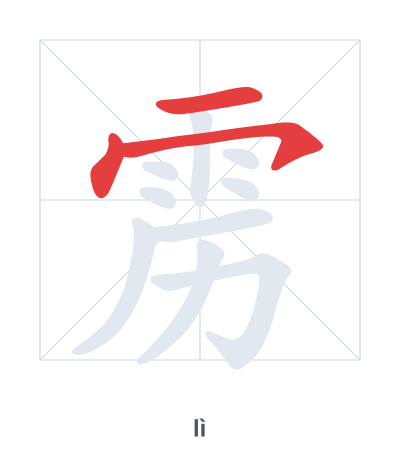
Open Hanzi Writer to see the animated stroke order and practice writing 雳 with real-time feedback.
The character 雳 (lì) is written with 12 strokes. Follow the standard Chinese stroke order: top to bottom, left to right, outside before inside. The radical 雨 is one of its key components.
Practice the correct stroke order with the Hanzi Writer app to see animated stroke-by-stroke guidance with real-time feedback.
雳 means thunderclap.
雳 is a phono-semantic compound: the radical 雨 (rain) signifies weather phenomena, while the phonetic component 历 (lì, meaning 'to pass through') hints at the pronunciation. Together, they depict a thunderclap—a sudden, powerful sound bursting through rainy skies.
💡 Memory Tip: Picture rain (雨) falling on a calendar (历) that suddenly explodes with a thunderous boom.
天空响起一声霹雳。
tiān kōng xiǎng qǐ yī shēng pī lì
A sudden thunderclap rang out in the sky.
这消息真是晴天霹雳。
zhè xiāo xī zhēn shì qíng tiān pī lì
This news is a real bolt from the blue.
他喜欢跳霹雳舞。
tā xǐ huān tiào pī lì wǔ
He likes breakdancing.
Open Hanzi Writer to see the animated stroke order and practice writing 雳 with real-time feedback.
✨ Animated stroke order · Handwriting recognition · HSK-graded practice · Free to use
The character 雳 combines the radical 雨 (rain) on top and a phonetic component 厉 (lì) below. The rain radical suggests something from the sky, like a storm, while the component 厉 adds the sound and the idea of severity. Together, they create the image of a powerful thunderclap.