零 (líng) means "zero" in Chinese. It has 13 strokes with the radical 雨, and is HSK Level 1.
Rated 3.7/5 in difficulty (challenging).
Harder than 99% of HSK Level 1 characters.
Appears in 3+ common words including 零钱 (líng qián), 零件 (líng jiàn), 零下 (líng xià).
Due to its 13 strokes, Hanzi Writer's error detection shows 零 requires focused practice — most learners need 10+ attempts for consistent accuracy.
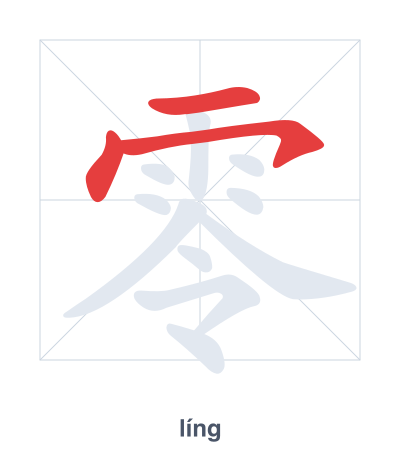
Open Hanzi Writer to see the animated stroke order and practice writing 零 with real-time feedback.
The character 零 (líng) is written with 13 strokes. Follow the standard Chinese stroke order: top to bottom, left to right, outside before inside. The radical 雨 is one of its key components.
Practice the correct stroke order with the Hanzi Writer app to see animated stroke-by-stroke guidance with real-time feedback.
零 means zero.
As an HSK Level 1 character, 零 is among the first characters beginners learn.
Originally a compound with 雨 (rain) as the semantic component and 令 (lìng) as phonetic, 零 once meant 'light rain' or 'drizzle'. Over time its meaning shifted to 'fall' (as in 零落), and eventually it was borrowed to represent the number zero, possibly through association with 'empty' or 'remnant'.
💡 Memory Tip: Picture rain (雨) falling as zero drops because a command (令) orders it to stop completely.
你有零钱吗?
nǐ yǒu líng qián ma
Do you have any change?
这个零件坏了。
zhè ge líng jiàn huài le
This part is broken.
现在是零下五度。
xiàn zài shì líng xià wǔ dù
It is five degrees below zero now.
Open Hanzi Writer to see the animated stroke order and practice writing 零 with real-time feedback.
✨ Animated stroke order · Handwriting recognition · HSK-graded practice · Free to use
The character 零 is composed of the radical 雨 (rain) on top and the phonetic component 令 (lìng) below. The rain radical hints at the original meaning related to light rain or drizzle, but today 零 primarily means 'zero' or 'nought' in numbers.