雾 (wù) means "Fog" in Chinese. It has 13 strokes with the radical 雨, and is HSK Level 7.
Rated 4.2/5 in difficulty (advanced).
Harder than 96% of HSK Level 7 characters.
Appears in 3+ common words including 大雾 (dà wù), 雾霾 (wù mái), 雾气 (wù qì).
Due to its 13 strokes, Hanzi Writer's error detection shows 雾 requires focused practice — most learners need 10+ attempts for consistent accuracy.
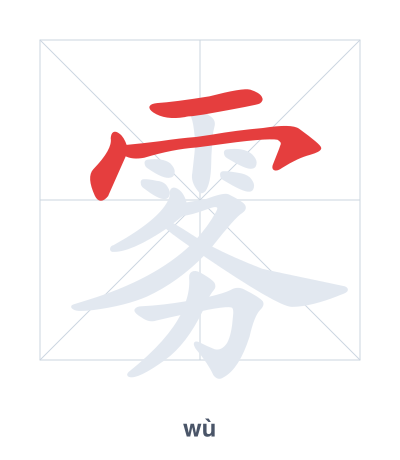
Open Hanzi Writer to see the animated stroke order and practice writing 雾 with real-time feedback.
The character 雾 (wù) is written with 13 strokes. Follow the standard Chinese stroke order: top to bottom, left to right, outside before inside. The radical 雨 is one of its key components.
Practice the correct stroke order with the Hanzi Writer app to see animated stroke-by-stroke guidance with real-time feedback.
雾 means Fog.
As an HSK Level 7 character, 雾 is an intermediate-level character.
雾 is a phono-semantic compound where the radical 雨 (rain) indicates a weather phenomenon, and 务 (wù) provides the pronunciation. The character visually suggests fog as a type of rain-related mist, like rain transformed into a haze that obscures vision.
💡 Memory Tip: Imagine rain (雨) turning your daily business (务) into a thick, blurry fog that hides everything.
今天的大雾很浓。
jīn tiān de dà wù hěn nóng
Today's fog is very thick.
北京今天有雾霾。
běi jīng jīn tiān yǒu wù mái
There is smog in Beijing today.
窗户上有雾气。
chuāng hù shàng yǒu wù qì
There is mist on the window.
Open Hanzi Writer to see the animated stroke order and practice writing 雾 with real-time feedback.
✨ Animated stroke order · Handwriting recognition · HSK-graded practice · Free to use
The character 雾 consists of the radical 雨 (rain) on top and 务 (wù, meaning 'affair' or 'business') below. The rain radical indicates weather-related phenomena, while 务 provides the pronunciation. Together, they create the idea of a weather condition that looks like rain but is actually fog.