雹 (báo) means "Hail" in Chinese. It has 13 strokes with the radical 雨.
Rated 4.2/5 in difficulty (advanced).
Appears in 3+ common words including 冰雹 (bīng báo), 雹灾 (báo zāi), 下雹子 (xià báo zi).
Due to its 13 strokes, Hanzi Writer's error detection shows 雹 requires focused practice — most learners need 10+ attempts for consistent accuracy.
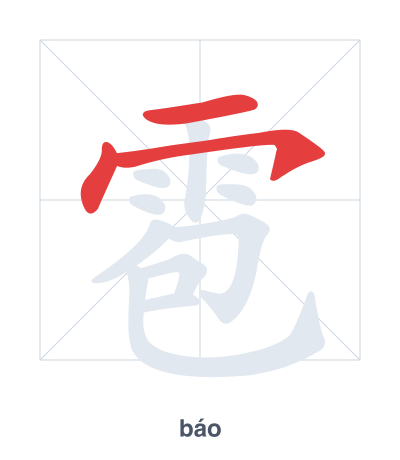
Open Hanzi Writer to see the animated stroke order and practice writing 雹 with real-time feedback.
The character 雹 (báo) is written with 13 strokes. Follow the standard Chinese stroke order: top to bottom, left to right, outside before inside. The radical 雨 is one of its key components.
Practice the correct stroke order with the Hanzi Writer app to see animated stroke-by-stroke guidance with real-time feedback.
雹 means Hail.
雹 combines the rain radical (雨) with 包 (bāo, 'to wrap'), suggesting hail as rain that has been 'wrapped' into frozen pellets. The upper part shows clouds releasing precipitation, while the lower part hints at the encased, compact form of hailstones.
💡 Memory Tip: Picture rain (雨) falling onto a wrapped package (包) that bursts open, scattering icy hailstones everywhere.
刚才下了冰雹。
gāng cái xià le bīng báo
It hailed just now.
农田受了雹灾。
nóng tián shòu le báo zāi
The farmland was damaged by hail.
天空开始下雹子。
tiān kōng kāi shǐ xià báo zi
It started to hail.
Open Hanzi Writer to see the animated stroke order and practice writing 雹 with real-time feedback.
✨ Animated stroke order · Handwriting recognition · HSK-graded practice · Free to use
The character 雹 combines the radical 雨 (rain) on top with 包 (bāo, meaning "to wrap") on the bottom. This structure suggests "rain that is wrapped" - hail forms when raindrops are wrapped in layers of ice inside storm clouds. The top component shows it is a weather phenomenon, while the bottom hints at the ice being enclosed.