雩 (yú) means "rain prayer ritual" in Chinese. It has 11 strokes with the radical 雨.
Rated 4.2/5 in difficulty (advanced).
Appears in 3+ common words including 雩祭 (yú jì), 雩舞 (yú wǔ), 雩祷 (yú dǎo).
Due to its 11 strokes, Hanzi Writer's error detection shows 雩 requires focused practice — most learners need 10+ attempts for consistent accuracy.
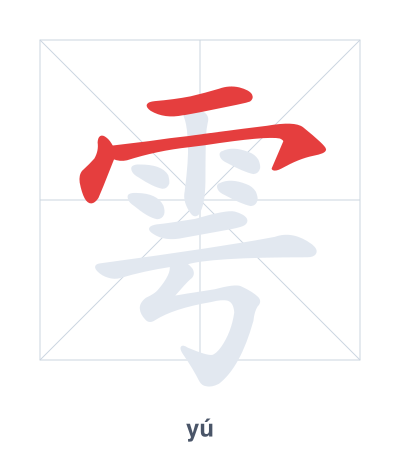
Open Hanzi Writer to see the animated stroke order and practice writing 雩 with real-time feedback.
The character 雩 (yú) is written with 11 strokes. Follow the standard Chinese stroke order: top to bottom, left to right, outside before inside. The radical 雨 is one of its key components.
Practice the correct stroke order with the Hanzi Writer app to see animated stroke-by-stroke guidance with real-time feedback.
雩 means rain prayer ritual.
雩 is a phono-semantic compound. The top part 雨 (rain) signifies the semantic field of precipitation, while the bottom 于 (yú) acts as a phonetic component. Together, they depict a ritual ceremony performed to pray for rain.
💡 Memory Tip: Imagine a shaman (于, like a person with arms raised) standing under the rain (雨) performing the ancient rain prayer ritual.
古代通过雩祭求雨。
gǔ dài tōng guò yú jì qiú yǔ
In ancient times, people prayed for rain through Yu sacrifices.
祭司在跳雩舞。
jì sī zài tiào yú wǔ
The priest is performing the rain dance.
雩祷是一种仪式。
yú dǎo shì yī zhǒng yí shì
Praying for rain is a type of ritual.
Open Hanzi Writer to see the animated stroke order and practice writing 雩 with real-time feedback.
✨ Animated stroke order · Handwriting recognition · HSK-graded practice · Free to use
雩 is made of two parts: the top is 雨 (rain), showing the weather element, and the bottom is 亏, which gives the sound (yú). The rain radical directly connects to the meaning of a ritual for rain, while 亏 acts as a phonetic hint.