地 (de/dì) means "Ground; earth; land; floor" in Chinese. It has 6 strokes with the radical 土, and is HSK Level 1.
Rated 2.7/5 in difficulty (moderate).
Harder than 41% of HSK Level 1 characters.
Appears in 5+ common words including 土地 (tǔ dì), 地球 (dì qiú), 慢慢地 (màn màn dì).
Hanzi Writer's stroke validation shows learners typically need 5-8 attempts to write 地 with correct proportion and order.
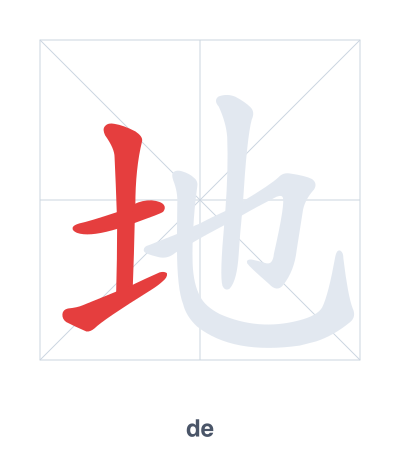
Open Hanzi Writer to see the animated stroke order and practice writing 地 with real-time feedback.
The character 地 (de/dì) is written with 6 strokes. Follow the standard Chinese stroke order: top to bottom, left to right, outside before inside. The radical 土 is one of its key components.
Practice the correct stroke order with the Hanzi Writer app to see animated stroke-by-stroke guidance with real-time feedback.
地 means Ground; earth; land; floor.
This is a polyphonic character with readings: de, dì.
As an HSK Level 1 character, 地 is among the first characters beginners learn.
地 is a compound character where the radical 土 (earth) provides the meaning, while the component 也 (originally a pictograph of a snake or scorpion) serves as a phonetic element indicating the pronunciation 'de' in ancient Chinese. Together, they convey the idea of the ground or land beneath one's feet.
💡 Memory Tip: Picture a snake (也) slithering across the earth (土) to mark its territory on the ground.
农民们在这片土地上辛勤耕耘。
nóng mín men zài zhè piàn tǔ dì shàng xīn qín gēng yún
Farmers work hard tilling the soil on this land.
地球是人类赖以生存的家园。
dì qiú shì rén lèi lài yǐ shēng cún de jiā yuán
The Earth is the home on which humanity depends for survival.
他慢慢地走在公园的小径上。
tā màn màn dì zǒu zài gōng yuán de xiǎo jìng shàng
He walked slowly along the path in the park.
汽车在高速公路上飞快地行驶。
qì chē zài gāo sù gōng lù shàng fēi kuài dì xíng shǐ
The car is driving fast on the highway.
Open Hanzi Writer to see the animated stroke order and practice writing 地 with real-time feedback.
✨ Animated stroke order · Handwriting recognition · HSK-graded practice · Free to use
The left part is 土, meaning 'earth' or 'soil', which directly connects to the character's meaning of ground or land. The right part is 也, which originally served as a phonetic clue, though the pronunciation has shifted over time.