霁 (jì) means "To clear up (after rain)" in Chinese. It has 14 strokes with the radical 雨.
Rated 4.2/5 in difficulty (advanced).
Appears in 3+ common words including 雨霁 (yǔ jì), 雪霁 (xuě jì), 霁月 (jì yuè).
Due to its 14 strokes, Hanzi Writer's error detection shows 霁 requires focused practice — most learners need 10+ attempts for consistent accuracy.
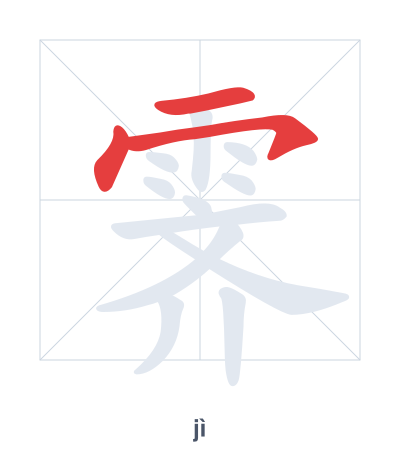
Open Hanzi Writer to see the animated stroke order and practice writing 霁 with real-time feedback.
The character 霁 (jì) is written with 14 strokes. Follow the standard Chinese stroke order: top to bottom, left to right, outside before inside. The radical 雨 is one of its key components.
Practice the correct stroke order with the Hanzi Writer app to see animated stroke-by-stroke guidance with real-time feedback.
霁 means To clear up (after rain).
霁 combines the radical 雨 (rain) and the component 齐 (qí, meaning 'even' or 'level'). The 雨 suggests weather, while 齐 hints at the sky becoming even and clear after rain stops. Originally, the character depicted the rain ceasing and the skies leveling out into a clear state.
💡 Memory Tip: Picture rain (雨) falling in an orderly, even pattern (齐), then suddenly stopping as the clouds part and the sky clears up.
雨霁后的空气很清新。
yǔ jì hòu de kōng qì hěn qīng xīn
The air is very fresh after the rain clears.
雪霁后的景色很美。
xuě jì hòu de jǐng sè hěn měi
The scenery after the snow clears is beautiful.
今晚的霁月很亮。
jīn wǎn de jì yuè hěn liàng
The bright moon after the rain is very bright tonight.
Open Hanzi Writer to see the animated stroke order and practice writing 霁 with real-time feedback.
✨ Animated stroke order · Handwriting recognition · HSK-graded practice · Free to use
霁 is composed of the radical 雨 (rain) on top and 齐 (qí, meaning 'neat' or 'orderly') below. The rain radical indicates weather, and 齐 suggests the sky becoming orderly after rain stops. Together they show the idea of clearing up after rainfall.