扣 (kòu) means "to button or deduct" in Chinese. It has 6 strokes with the radical 扌, and is HSK Level 6.
Rated 3.2/5 in difficulty (challenging).
Harder than 13% of HSK Level 6 characters.
Appears in 3+ common words including 扣子 (kòu zi), 折扣 (zhé kòu), 扣分 (kòu fēn).
Due to its 6 strokes, Hanzi Writer's error detection shows 扣 requires focused practice — most learners need 10+ attempts for consistent accuracy.
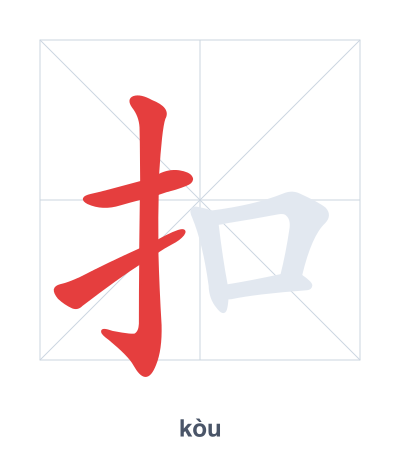
Open Hanzi Writer to see the animated stroke order and practice writing 扣 with real-time feedback.
The character 扣 (kòu) is written with 6 strokes. Follow the standard Chinese stroke order: top to bottom, left to right, outside before inside. The radical 扌 is one of its key components.
Practice the correct stroke order with the Hanzi Writer app to see animated stroke-by-stroke guidance with real-time feedback.
扣 means to button or deduct.
As an HSK Level 6 character, 扣 is an intermediate-level character.
扣 combines the hand radical 扌 with 口 (mouth). The hand performs an action of pressing or closing, while the mouth suggests an opening or loop that is being fastened, like buttoning a garment. By extension, this also came to mean 'to deduct,' as in pulling back or withholding something from a total.
💡 Memory Tip: Imagine your hand (扌) using a button to close a mouth (口) so it can't speak—'button it up' or 'deduct' words.
他的扣子掉了。
tā de kòu zi diào le
His button fell off.
这家店有折扣。
zhè jiā diàn yǒu zhé kòu
This shop has discounts.
考试被扣分了。
kǎo shì bèi kòu fēn le
Points were deducted from the exam.
Open Hanzi Writer to see the animated stroke order and practice writing 扣 with real-time feedback.
✨ Animated stroke order · Handwriting recognition · HSK-graded practice · Free to use
The character 扣 is composed of the hand radical 扌 on the left and the mouth radical 口 on the right. The hand radical suggests an action done with the hand, such as fastening a button, while the mouth shape can represent the buttonhole or the act of pressing to close.