折 (shé/zhē/zhé) means "to fold; to break; discount" in Chinese. It has 7 strokes with the radical 扌, and is HSK Level 4.
Rated 3.5/5 in difficulty (challenging).
Harder than 33% of HSK Level 4 characters.
Appears in 5+ common words including 折断 (zhé duàn), 折扣 (zhé kòu), 折腾 (zhē teng).
Due to its 7 strokes, Hanzi Writer's error detection shows 折 requires focused practice — most learners need 10+ attempts for consistent accuracy.
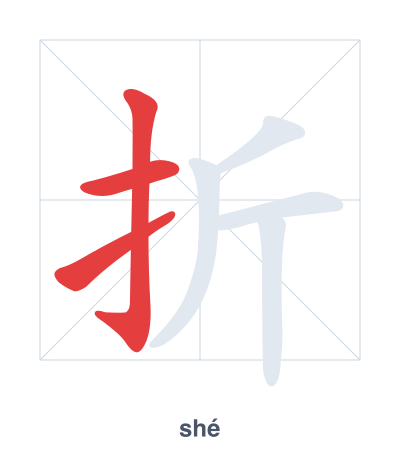
Open Hanzi Writer to see the animated stroke order and practice writing 折 with real-time feedback.
The character 折 (shé/zhē/zhé) is written with 7 strokes. Follow the standard Chinese stroke order: top to bottom, left to right, outside before inside. The radical 扌 is one of its key components.
Practice the correct stroke order with the Hanzi Writer app to see animated stroke-by-stroke guidance with real-time feedback.
折 means to fold; to break; discount.
This is a polyphonic character with readings: shé, zhē, zhé.
As an HSK Level 4 character, 折 is an intermediate-level character.
折 combines the hand radical 扌 with 斤 (axe) to show a hand holding an axe that breaks or cuts something. In ancient script, a hand with an axe chopping wood depicted the action of folding or breaking.
💡 Memory Tip: Imagine your hand (扌) gripping an axe (斤) and snapping a thick branch in half with a single chop.
强风吹过,把路边的小树苗折断了。
qiáng fēng chuī guò bǎ lù biān de xiǎo shù miáo zhé duàn le
A strong wind blew and snapped the small saplings by the roadside.
商场正在进行年终大促销,折扣力度很大。
shāng chǎng zhèng zài jìn xíng nián zhōng dà cù xiāo zhé kòu lì dù hěn dà
The mall is having a year-end big sale with deep discounts.
这孩子太淘气了,翻来覆去地折腾个不停。
zhè hái zi tài táo qì le fān lái fù qù dì zhē teng gè bù tíng
This child is so naughty, fidgeting and tossing about non-stop.
他的这笔生意做亏了,最后还折本不少。
tā de zhè bǐ shēng yì zuò kuī le zuì hòu hái shé běn bù shǎo
He lost money on this business deal and ended up losing a lot of capital.
Open Hanzi Writer to see the animated stroke order and practice writing 折 with real-time feedback.
✨ Animated stroke order · Handwriting recognition · HSK-graded practice · Free to use
The left side is 扌, the hand radical, showing that an action is done by hand. The right side is 斤, which means an axe or a cutting tool. Together, they suggest using a hand-held tool to break or fold something.