控 (kòng) means "to control / to accuse" in Chinese. It has 11 strokes with the radical 扌, and is HSK Level 5.
Rated 4.2/5 in difficulty (advanced).
Harder than 70% of HSK Level 5 characters.
Appears in 3+ common words including 控制 (kòng zhì), 遥控 (yáo kòng), 监控 (jiān kòng).
Due to its 11 strokes, Hanzi Writer's error detection shows 控 requires focused practice — most learners need 10+ attempts for consistent accuracy.
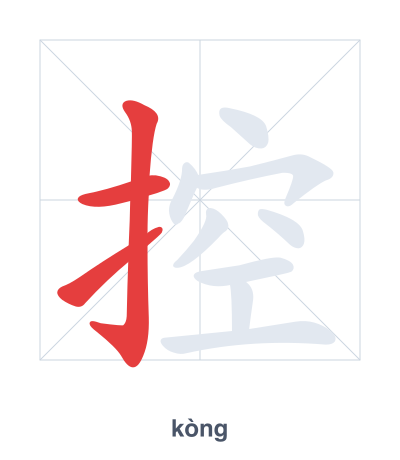
Open Hanzi Writer to see the animated stroke order and practice writing 控 with real-time feedback.
The character 控 (kòng) is written with 11 strokes. Follow the standard Chinese stroke order: top to bottom, left to right, outside before inside. The radical 扌 is one of its key components.
Practice the correct stroke order with the Hanzi Writer app to see animated stroke-by-stroke guidance with real-time feedback.
控 means to control / to accuse.
As an HSK Level 5 character, 控 is an intermediate-level character.
控 combines the hand radical 扌, indicating an action, with 空 (kōng, 'empty/sky'), which serves as a phonetic component. The original meaning was to pull or draw a bow, as the hand controls the bowstring to create tension in the empty space—later extended to 'control' and 'accuse' (as in directing blame).
💡 Memory Tip: Picture your hand (扌) pulling an invisible bow against an empty sky (空) to control the aim and accuse your target of cheating.
司机控制了车速。
sī jī kòng zhì le chē sù
The driver controlled the speed.
遥控器在哪里?
yáo kòng qì zài nǎ lǐ
Where is the remote control?
商店里有监控。
shāng diàn lǐ yǒu jiān kòng
There is surveillance in the store.
Open Hanzi Writer to see the animated stroke order and practice writing 控 with real-time feedback.
✨ Animated stroke order · Handwriting recognition · HSK-graded practice · Free to use
控 is made of the hand radical 扌 on the left and 空 (empty/sky) on the right. The hand radical suggests an action done with the hand, like controlling or accusing. The right side 空 provides the pronunciation but also hints at "controlling something empty" or "pointing an empty finger" in accusation.