制 (zhì) means "To make / To control / To restrict." in Chinese. It has 8 strokes with the radical 刂, and is HSK Level 3.
Rated 3.4/5 in difficulty (challenging).
Harder than 35% of HSK Level 3 characters.
Appears in 3+ common words including 制作 (zhì zuò), 制度 (zhì dù), 控制 (kòng zhì).
Due to its 8 strokes, Hanzi Writer's error detection shows 制 requires focused practice — most learners need 10+ attempts for consistent accuracy.
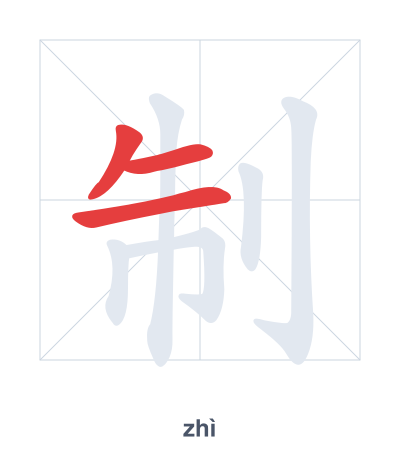
Open Hanzi Writer to see the animated stroke order and practice writing 制 with real-time feedback.
The character 制 (zhì) is written with 8 strokes. Follow the standard Chinese stroke order: top to bottom, left to right, outside before inside. The radical 刂 is one of its key components.
Practice the correct stroke order with the Hanzi Writer app to see animated stroke-by-stroke guidance with real-time feedback.
制 means To make / To control / To restrict..
As an HSK Level 3 character, 制 is an intermediate-level character.
This compound character combines 未 (a tree with branches) and 刂 (knife). In ancient forms, it depicted a knife cutting a tree to shape wood, giving the original meaning 'to make' or 'to fashion'. This later extended to 'to control' and 'to restrict' by the idea of cutting something down to size or imposing limits.
💡 Memory Tip: Picture a knife (刂) slicing off the unruly branches (未) of a tree to make it neat and control its growth.
老师教我们制作风筝。
lǎo shī jiào wǒ men zhì zuò fēng zhēng
The teacher taught us how to make kites.
我们要遵守公司的制度。
wǒ men yào zūn shǒu gōng sī de zhì dù
We must follow the company's regulations.
请控制好你的速度。
qǐng kòng zhì hǎo nǐ de sù dù
Please control your speed.
Open Hanzi Writer to see the animated stroke order and practice writing 制 with real-time feedback.
✨ Animated stroke order · Handwriting recognition · HSK-graded practice · Free to use
The character 制 is made of two parts: on the left is 牛 (cow) or a simplified form of 牛, and on the right is 刂 (knife). The knife radical suggests cutting or shaping, which relates to "making" something, while the cow part can hint at leather or raw material used in production. Together, the components convey the idea of controlling or restricting by cutting or setting rules.