拭 (shì) means "to wipe" in Chinese. It has 9 strokes with the radical 扌.
Rated 4/5 in difficulty (challenging).
Appears in 3+ common words including 擦拭 (cā shì), 拭去 (shì qù), 拭目以待 (shì mù yǐ dài).
Due to its 9 strokes, Hanzi Writer's error detection shows 拭 requires focused practice — most learners need 10+ attempts for consistent accuracy.
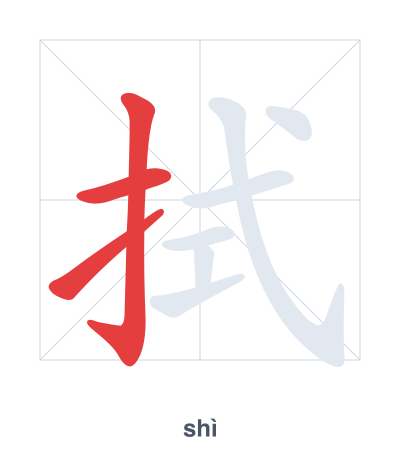
Open Hanzi Writer to see the animated stroke order and practice writing 拭 with real-time feedback.
The character 拭 (shì) is written with 9 strokes. Follow the standard Chinese stroke order: top to bottom, left to right, outside before inside. The radical 扌 is one of its key components.
Practice the correct stroke order with the Hanzi Writer app to see animated stroke-by-stroke guidance with real-time feedback.
拭 means to wipe.
拭 is a phono-semantic compound: the radical 扌 (hand) indicates the action of wiping, while 式 (shì) provides the pronunciation and originally also carried a sense of 'pattern' or 'style'—the idea being a hand moving in a patterned motion to wipe something clean.
💡 Memory Tip: Picture a hand (扌) holding a patterned cloth (式) and using it to wipe a dirty table.
轻轻擦拭桌面。
qīng qīng cā shì zhuō miàn
Gently wipe the tabletop.
她拭去了眼泪。
tā shì qù le yǎn lèi
She wiped away her tears.
我们拭目以待吧。
wǒ men shì mù yǐ dài ba
Let's wait and see.
Open Hanzi Writer to see the animated stroke order and practice writing 拭 with real-time feedback.
✨ Animated stroke order · Handwriting recognition · HSK-graded practice · Free to use
拭 combines the hand radical 扌 on the left with 式 on the right. The 扌 shows it is a hand action, while 式 gives the pronunciation shì, so together it means to wipe using hand movement.