颗 (kē) means "classifier for small spheres or grains" in Chinese. It has 14 strokes with the radical 页, and is HSK Level 5.
Rated 4.2/5 in difficulty (advanced).
Harder than 99% of HSK Level 5 characters.
Appears in 3+ common words including 一颗 (yī kē), 颗粒 (kē lì), 几颗 (jǐ kē).
Due to its 14 strokes, Hanzi Writer's error detection shows 颗 requires focused practice — most learners need 10+ attempts for consistent accuracy.
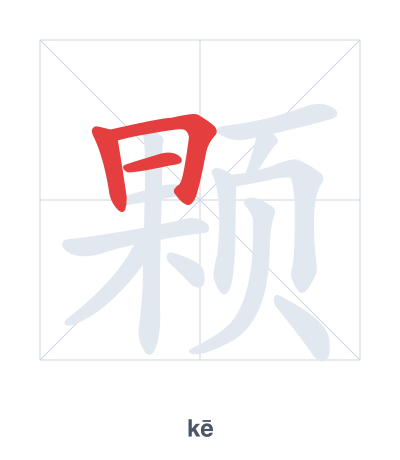
Open Hanzi Writer to see the animated stroke order and practice writing 颗 with real-time feedback.
The character 颗 (kē) is written with 14 strokes. Follow the standard Chinese stroke order: top to bottom, left to right, outside before inside. The radical 页 is one of its key components.
Practice the correct stroke order with the Hanzi Writer app to see animated stroke-by-stroke guidance with real-time feedback.
颗 means classifier for small spheres or grains.
As an HSK Level 5 character, 颗 is an intermediate-level character.
颗 combines 果 (fruit, grain) and 页 (head), originally depicting a small round head or fruit, later used as a classifier for small spherical objects like grains or pearls.
💡 Memory Tip: Picture a tiny fruit (果) with a head (页) that is round like a grain—that's one 颗.
我吃了一颗糖。
wǒ chī le yī kē táng
I ate a piece of candy.
这种大米颗粒饱满。
zhè zhǒng dà mǐ kē lì bǎo mǎn
This rice has plump and full grains.
天上有几颗星星。
tiān shàng yǒu jǐ kē xīng xīng
There are a few stars in the sky.
Open Hanzi Writer to see the animated stroke order and practice writing 颗 with real-time feedback.
✨ Animated stroke order · Handwriting recognition · HSK-graded practice · Free to use
颗 is made of 果 (fruit) on the left and 页 (head/page) on the right. The 果 part suggests something round like a fruit, while 页 originally meant head, giving the idea of a small round object. Together, they form a classifier for small spheres or grains.