Hanzi Writer

How to Write 颉 (jié/xié) — Meaning “to fly upwards / (used in names)”

jié/xié 12 strokes Radical: 页

颉 (jié/xié) means "to fly upwards / (used in names)" in Chinese. It has 12 strokes with the radical 页.

Rated 4.2/5 in difficulty (advanced).

Appears in 2+ common words including 仓颉 (cāng jié), 颉颃 (xié háng).

Due to its 12 strokes, Hanzi Writer's error detection shows 颉 requires focused practice — most learners need 10+ attempts for consistent accuracy.
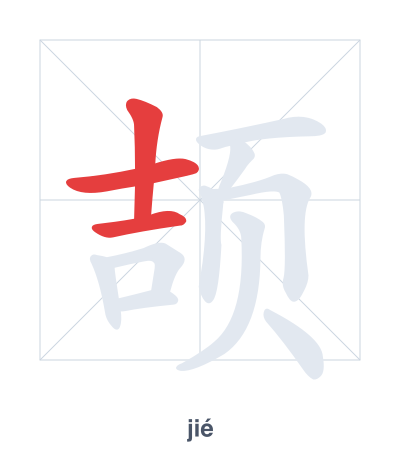
Stroke order practice for 颉 - jié/xié

Practice Writing 颉 (jié/xié)

Open Hanzi Writer to see the animated stroke order and practice writing 颉 with real-time feedback.

The character (jié/xié) is written with 12 strokes. Follow the standard Chinese stroke order: top to bottom, left to right, outside before inside. The radical is one of its key components.

Practice the correct stroke order with the Hanzi Writer app to see animated stroke-by-stroke guidance with real-time feedback.

means to fly upwards / (used in names).

This is a polyphonic character with readings: jié, xié.

Character
Pinyinjié / xié (jie/xie)
Meaningto fly upwards / (used in names)
Strokes12
Radical
Difficulty4.2/5

颉 combines the phonetic component 吉 (jié, 'auspicious') with the semantic component 页 (head). The head rising suggests the action of lifting upwards, leading to the meaning 'to fly upwards' or 'soar'—as if raising one's head toward the sky.

💡 Memory Tip: Imagine a lucky (吉) bird craning its head (页) upwards as it takes flight.

cāng jié
Cangjie (legendary inventor of Chinese characters)
xié háng
to fly up and down / to compete / to be equally matched

仓颉创造了汉字。

cāng jié chuàng zào le hàn zì

Cangjie created Chinese characters.

两人实力不相颉颃。

liǎng rén shí lì bù xiāng xié háng

The two are not equal in strength.

仓颉是古代的传说。

cāng jié shì gǔ dài de chuán shuō

Cangjie is an ancient legend.

Character Pinyin Strokes Radical
(current) jié / xié 12
10
wán 10
10
Stroke order practice for 颉 - jié/xié

Practice Writing 颉 (jié/xié)

Open Hanzi Writer to see the animated stroke order and practice writing 颉 with real-time feedback.

✨ Animated stroke order · Handwriting recognition · HSK-graded practice · Free to use

Frequently Asked Questions about 颉

颉 is composed of 吉 (jí, 'lucky') on the left and 页 (yè, 'head' or 'page') on the right. The radical 页 suggests a connection to the head, but the meaning 'to fly upwards' comes from ancient usage, not from these parts directly. The structure helps identify the character but not its exact meaning.

Characters with Radical 页

Other 12-Stroke Characters