顼 (xū) means "Anxious / Grieved" in Chinese. It has 10 strokes with the radical 页.
Rated 4.2/5 in difficulty (advanced).
Appears in 3+ common words including 颛顼 (zhuān xū), 顼顼 (xū xū), 姓顼 (xìng xū).
Due to its 10 strokes, Hanzi Writer's error detection shows 顼 requires focused practice — most learners need 10+ attempts for consistent accuracy.
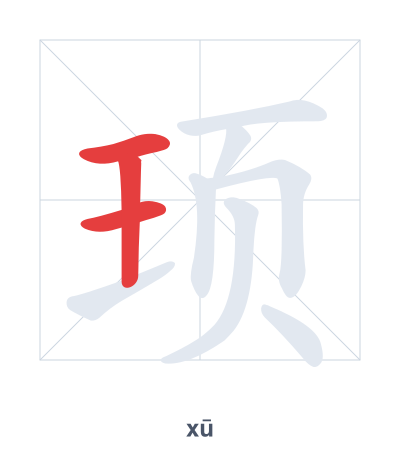
Open Hanzi Writer to see the animated stroke order and practice writing 顼 with real-time feedback.
The character 顼 (xū) is written with 10 strokes. Follow the standard Chinese stroke order: top to bottom, left to right, outside before inside. The radical 页 is one of its key components.
Practice the correct stroke order with the Hanzi Writer app to see animated stroke-by-stroke guidance with real-time feedback.
顼 means Anxious / Grieved.
The character 顼 combines the radical 页 (head) with the component 工 (work), suggesting a head burdened by work or worry. This visual composition implies the anxious, grieved state of someone overwhelmed by labor or stress. Historically, the character was also used in the name of the ancient emperor Zhuanxu, but its meaning of anxiety arises from this compound structure.
💡 Memory Tip: Imagine a head (页) with a heavy workbench (工) balanced on top, causing a pained, anxious expression.
颛顼是古代的帝王。
zhuān xū shì gǔ dài de dì wáng
Zhuanxu was an ancient emperor.
他做事顼顼的样子。
tā zuò shì xū xū de yàng zi
He appears fussy and narrow-minded when doing things.
他的老师姓顼。
tā de lǎo shī xìng xū
His teacher's surname is Xu.
Open Hanzi Writer to see the animated stroke order and practice writing 顼 with real-time feedback.
✨ Animated stroke order · Handwriting recognition · HSK-graded practice · Free to use
The character 顼 is made of left component 王 (king) and right component 页 (head/page). While the meaning 'anxious' or 'grieved' does not directly come from these parts, the 页 component often relates to the head, suggesting facial expressions of worry. The left 王 may have been a phonetic element in ancient times.