颊 (jiá) means "cheek" in Chinese. It has 12 strokes with the radical 页, and is HSK Level 7.
Rated 4.2/5 in difficulty (advanced).
Harder than 97% of HSK Level 7 characters.
Appears in 3+ common words including 脸颊 (liǎn jiá), 颊部 (jiá bù), 腮颊 (sāi jiá).
Due to its 12 strokes, Hanzi Writer's error detection shows 颊 requires focused practice — most learners need 10+ attempts for consistent accuracy.
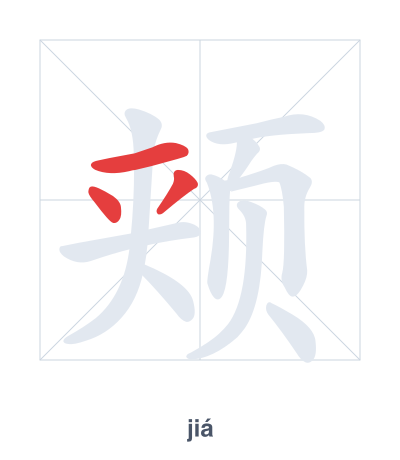
Open Hanzi Writer to see the animated stroke order and practice writing 颊 with real-time feedback.
The character 颊 (jiá) is written with 12 strokes. Follow the standard Chinese stroke order: top to bottom, left to right, outside before inside. The radical 页 is one of its key components.
Practice the correct stroke order with the Hanzi Writer app to see animated stroke-by-stroke guidance with real-time feedback.
颊 means cheek.
As an HSK Level 7 character, 颊 is an intermediate-level character.
颊 combines the radical 页 (head/face) with 夹 (to squeeze, also phonetic). The cheek is the soft side of the face that can be squeezed or pinched between the fingers.
💡 Memory Tip: Imagine a giant clamp (夹) pinching the side of a head (页) right on the cheek.
她的脸颊红了。
tā de liǎn jiá hóng le
Her cheeks turned red.
医生检查了她的颊部。
yī shēng jiǎn chá le tā de jiá bù
The doctor examined her cheek area.
他的腮颊鼓鼓的。
tā de sāi jiá gǔ gǔ de
His cheeks are bulging.
Open Hanzi Writer to see the animated stroke order and practice writing 颊 with real-time feedback.
✨ Animated stroke order · Handwriting recognition · HSK-graded practice · Free to use
颊 is a left-right character. The left component 夹 (jiā) suggests 'squeeze' or 'side', and the right radical 页 (yè) means 'head' or 'page', relating to the face. Together, they indicate the sides of the face — your cheeks.