Hanzi Writer

How to Write 顸 (hān) — Meaning “thick; stout; coarse”

hān 9 strokes Radical: 页

顸 (hān) means "thick; stout; coarse" in Chinese. It has 9 strokes with the radical 页.

Rated 4/5 in difficulty (challenging).

Appears in 3+ common words including 顸实 (hān shí), 顸大 (hān dà), 顸皮 (hān pí).

Due to its 9 strokes, Hanzi Writer's error detection shows 顸 requires focused practice — most learners need 10+ attempts for consistent accuracy.
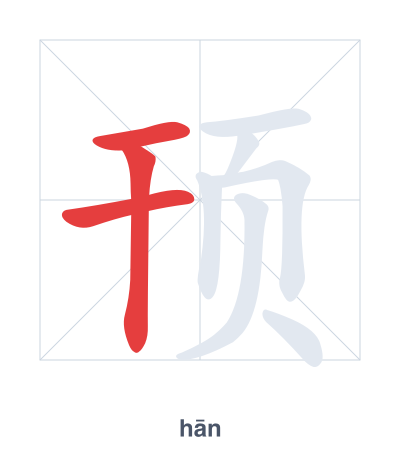
Stroke order practice for 顸 - hān

Practice Writing 顸 (hān)

Open Hanzi Writer to see the animated stroke order and practice writing 顸 with real-time feedback.

The character (hān) is written with 9 strokes. Follow the standard Chinese stroke order: top to bottom, left to right, outside before inside. The radical is one of its key components.

Practice the correct stroke order with the Hanzi Writer app to see animated stroke-by-stroke guidance with real-time feedback.

means thick; stout; coarse.

Character
Pinyinhān (han)
Meaningthick; stout; coarse
Strokes9
Radical
Difficulty4/5

The character 顸 combines the phonetic component 干 (gān) with the radical 页 (head). The radical 页 suggests the head, and together they imply a thick or stout head, which extends to the general meanings of thick, stout, or coarse.

💡 Memory Tip: Picture a head (页) so thick and stout that a dry pole (干) is stuck into it like a giant's clumsy club.

hān shí
thick and solid
hān dà
thick and large; bulky
hān pí
thick skin

这个木头很顸实。

zhè ge mù tou hěn hān shí

This piece of wood is very thick and solid.

他的手脚很顸大。

tā de shǒu jiǎo hěn hān dà

His hands and feet are very large.

这个瓜的皮很顸。

zhè ge guā de pí hěn hān

The skin of this melon is very thick.

Character Pinyin Strokes Radical
(current) hān 9
dǐng 8
qǐng 8
xiàng 9
Stroke order practice for 顸 - hān

Practice Writing 顸 (hān)

Open Hanzi Writer to see the animated stroke order and practice writing 顸 with real-time feedback.

✨ Animated stroke order · Handwriting recognition · HSK-graded practice · Free to use

Frequently Asked Questions about 顸

顸 is composed of 干 (gàn, meaning stem or trunk) on the left and 页 (yè, the radical for head or face) on the right. The 干 part suggests something thick and solid like a tree trunk, while 页 connects to the head, so together they imply a thick head or thick-skinned appearance, matching the meaning of thick, stout, or coarse.

Characters with Radical 页

Other 9-Stroke Characters