页 (yè) means "page; leaf" in Chinese. It has 6 strokes with the radical 页, and is HSK Level 1.
Rated 2.4/5 in difficulty (moderate).
Harder than 35% of HSK Level 1 characters.
Appears in 3+ common words including 第一页 (dì yī yè), 书页 (shū yè), 网页 (wǎng yè).
Hanzi Writer's stroke validation shows learners typically need 5-8 attempts to write 页 with correct proportion and order.
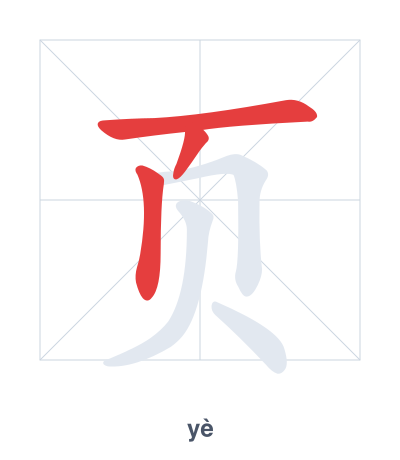
Open Hanzi Writer to see the animated stroke order and practice writing 页 with real-time feedback.
The character 页 (yè) is written with 6 strokes. Follow the standard Chinese stroke order: top to bottom, left to right, outside before inside. The radical 页 is one of its key components.
Practice the correct stroke order with the Hanzi Writer app to see animated stroke-by-stroke guidance with real-time feedback.
页 means page; leaf.
As an HSK Level 1 character, 页 is among the first characters beginners learn.
This character began as a pictograph of a person's head with hair, representing 'head' (its original meaning). Later, it was borrowed phonetically to mean 'page' or 'leaf of paper,' possibly because a page's flat rectangular shape vaguely resembles a head.
💡 Memory Tip: Imagine a page of paper (the square shape) with a horizontal line at top and a vertical line down the middle, like a bookmark reminding you it's a leaf (页) to be turned.
请看第一页。
qǐng kàn dì yī yè
Please look at page one.
书页很薄。
shū yè hěn báo
The pages of the book are very thin.
网页打不开了。
wǎng yè dǎ bù kāi le
The webpage cannot be opened.
Open Hanzi Writer to see the animated stroke order and practice writing 页 with real-time feedback.
✨ Animated stroke order · Handwriting recognition · HSK-graded practice · Free to use
The character 页 is both a radical and a standalone character. Its shape originally came from a pictograph of a human head with a prominent face, but over time it evolved to represent a 'page' or 'leaf' of a book, as pages resemble flat, sheet-like objects.