顶 (dǐng) means "top; crown; to push from below" in Chinese. It has 8 strokes with the radical 页, and is HSK Level 4.
Rated 3.7/5 in difficulty (challenging).
Harder than 52% of HSK Level 4 characters.
Appears in 3+ common words including 山顶 (shān dǐng), 顶楼 (dǐng lóu), 屋顶 (wū dǐng).
Due to its 8 strokes, Hanzi Writer's error detection shows 顶 requires focused practice — most learners need 10+ attempts for consistent accuracy.
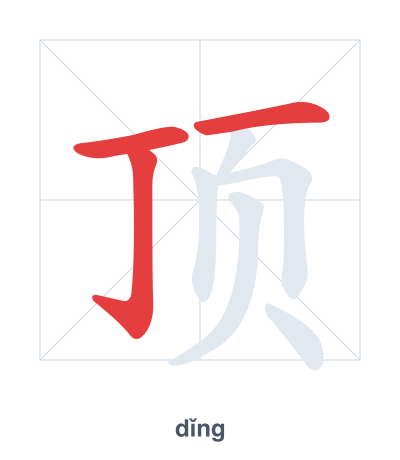
Open Hanzi Writer to see the animated stroke order and practice writing 顶 with real-time feedback.
The character 顶 (dǐng) is written with 8 strokes. Follow the standard Chinese stroke order: top to bottom, left to right, outside before inside. The radical 页 is one of its key components.
Practice the correct stroke order with the Hanzi Writer app to see animated stroke-by-stroke guidance with real-time feedback.
顶 means top; crown; to push from below.
As an HSK Level 4 character, 顶 is an intermediate-level character.
顶 combines the radical 页 (head) with 丁 (nail, also phonetic), suggesting something like a nail on top of the head—the crown or highest point.
💡 Memory Tip: Picture a nail (丁) driven into the top of a head (页) to mark the very top or crown.
我们到了山顶。
wǒ men dào le shān dǐng
We reached the top of the mountain.
我住在顶楼。
wǒ zhù zài dǐng lóu
I live on the top floor.
屋顶是红色的。
wū dǐng shì hóng sè de
The roof is red.
Open Hanzi Writer to see the animated stroke order and practice writing 顶 with real-time feedback.
✨ Animated stroke order · Handwriting recognition · HSK-graded practice · Free to use
顶 is composed of the radical 页 (head, page) on the right and the phonetic component 丁 (dīng) on the left. The radical 页 relates to the head or top part of the body, which connects to the meaning of 'top' or 'crown'. This structure shows that the character originally referred to the top of the head, and later extended to mean any highest point.