倔 (jué/juè) means "Stubborn; gruff." in Chinese. It has 10 strokes with the radical 亻, and is HSK Level 7.
Rated 3.9/5 in difficulty (challenging).
Harder than 33% of HSK Level 7 characters.
Appears in 3+ common words including 倔强 (jué jiàng), 脾气倔 (pí qì jué), 倔头倔脑 (juè tóu juè nǎo).
Due to its 10 strokes, Hanzi Writer's error detection shows 倔 requires focused practice — most learners need 10+ attempts for consistent accuracy.
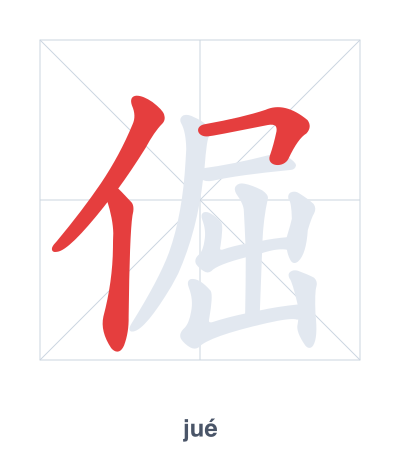
Open Hanzi Writer to see the animated stroke order and practice writing 倔 with real-time feedback.
The character 倔 (jué/juè) is written with 10 strokes. Follow the standard Chinese stroke order: top to bottom, left to right, outside before inside. The radical 亻 is one of its key components.
Practice the correct stroke order with the Hanzi Writer app to see animated stroke-by-stroke guidance with real-time feedback.
倔 means Stubborn; gruff..
This is a polyphonic character with readings: jué, juè.
As an HSK Level 7 character, 倔 is an intermediate-level character.
The character 倔 combines the radical 亻 (person) with 屈 (qū, meaning 'to bend' or 'to yield'), creating the image of a person who refuses to bend, hence stubborn or gruff.
💡 Memory Tip: Picture a person (亻) so stubborn they'd rather be twisted into a pretzel (屈) than give in.
他的性格很倔强。
tā de xìng gé hěn jué jiàng
His personality is very stubborn.
他的脾气倔得像头牛,谁劝都不听。
tā de pí qì jué dé xiàng tóu niú , shuí quàn dōu bù tīng 。
He is as stubborn as a mule and won't listen to anyone's advice.
他总是倔头倔脑的。
tā zǒng shì juè tóu juè nǎo de
He is always stubborn.
Open Hanzi Writer to see the animated stroke order and practice writing 倔 with real-time feedback.
✨ Animated stroke order · Handwriting recognition · HSK-graded practice · Free to use
倔 combines the radical 亻 (person) on the left with 屈 (qū, meaning "to bend" or "subdue") on the right. The person radical suggests a human trait, while 屈 implies something that refuses to bend — together they convey a person who is stubborn and unbending.