佩 (pèi) means "To wear / To admire" in Chinese. It has 8 strokes with the radical 亻, and is HSK Level 7.
Rated 3.4/5 in difficulty (challenging).
Harder than 12% of HSK Level 7 characters.
Appears in 3+ common words including 佩服 (pèi fú), 佩戴 (pèi dài), 玉佩 (yù pèi).
Due to its 8 strokes, Hanzi Writer's error detection shows 佩 requires focused practice — most learners need 10+ attempts for consistent accuracy.
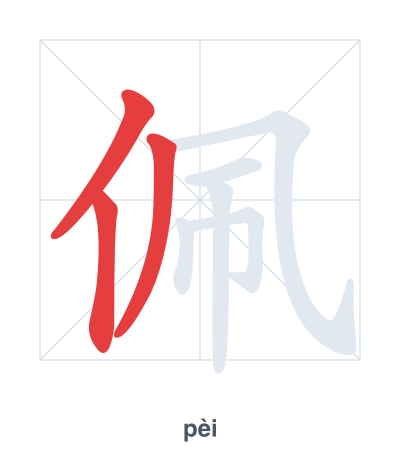
Open Hanzi Writer to see the animated stroke order and practice writing 佩 with real-time feedback.
The character 佩 (pèi) is written with 8 strokes. Follow the standard Chinese stroke order: top to bottom, left to right, outside before inside. The radical 亻 is one of its key components.
Practice the correct stroke order with the Hanzi Writer app to see animated stroke-by-stroke guidance with real-time feedback.
佩 means To wear / To admire.
As an HSK Level 7 character, 佩 is an intermediate-level character.
佩 combines the person radical 亻 with the cloth component 巾 and a phonetic element (from the ancient character for 'to step'), originally depicting a person wearing a sash or pendant hanging from the belt, hence 'to wear'. The meaning 'to admire' arose from the act of wearing an ornament to show respect or esteem.
💡 Memory Tip: Picture a person (亻) wearing a cloth (巾) as a pendant, secured by two small knots above, and they stand in admiration of their own accessory.
我很佩服你的勇气。
wǒ hěn pèi fú nǐ de yǒng qì
I really admire your courage.
他佩戴着校徽。
tā pèi dài zhe xiào huī
He is wearing the school badge.
这块玉佩很漂亮。
zhè kuài yù pèi hěn piào liàng
This jade pendant is very beautiful.
Open Hanzi Writer to see the animated stroke order and practice writing 佩 with real-time feedback.
✨ Animated stroke order · Handwriting recognition · HSK-graded practice · Free to use
佩 is made of the radical 亻 (person) on the left and 巿 (a cloth or sash) on the right. The person radical relates to wearing something, while the right part originally represented a sash or ornament worn at the waist. Together, they convey the idea of a person wearing an accessory, which led to the meanings 'to wear' and 'to admire'.