佯 (yáng) means "To pretend" in Chinese. It has 8 strokes with the radical 亻.
Rated 3.4/5 in difficulty (challenging).
Appears in 3+ common words including 佯装 (yáng zhuāng), 佯言 (yáng yán), 佯攻 (yáng gōng).
Due to its 8 strokes, Hanzi Writer's error detection shows 佯 requires focused practice — most learners need 10+ attempts for consistent accuracy.
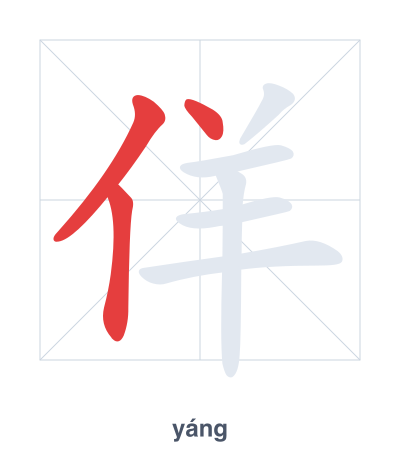
Open Hanzi Writer to see the animated stroke order and practice writing 佯 with real-time feedback.
The character 佯 (yáng) is written with 8 strokes. Follow the standard Chinese stroke order: top to bottom, left to right, outside before inside. The radical 亻 is one of its key components.
Practice the correct stroke order with the Hanzi Writer app to see animated stroke-by-stroke guidance with real-time feedback.
佯 means To pretend.
佯 combines the radical 亻 (person) with 羊 (sheep), which provides the pronunciation yáng. The character originally meant 'to pretend' or 'to feign,' possibly derived from the idea of a person acting like a sheep—deceptively harmless or obedient.
💡 Memory Tip: Imagine a person (亻) wearing a sheep costume (羊) to pretend they are a sheep, fooling everyone around.
他佯装不知道这件事。
tā yáng zhuāng bù zhī dào zhè jiàn shì
He pretended not to know about this.
他佯言要离开。
tā yáng yán yào lí kāi
He falsely claimed he was leaving.
这只是一次佯攻。
zhè zhǐ shì yī cì yáng gōng
This is just a feint attack.
Open Hanzi Writer to see the animated stroke order and practice writing 佯 with real-time feedback.
✨ Animated stroke order · Handwriting recognition · HSK-graded practice · Free to use
佯 is composed of the radical 亻 (person) on the left and 羊 (sheep) on the right. The person radical suggests human action, while 羊 provides pronunciation and hints at something false or deceptive, as sheep are sometimes associated with meek or pretend behavior. Together, the character conveys the idea of a person pretending or feigning.