脾 (pí) means "spleen" in Chinese. It has 12 strokes with the radical ⺼, and is HSK Level 5.
Rated 4.2/5 in difficulty (advanced).
Harder than 89% of HSK Level 5 characters.
Appears in 3+ common words including 脾气 (pí qì), 发脾气 (fā pí qì), 脾胃 (pí wèi).
Due to its 12 strokes, Hanzi Writer's error detection shows 脾 requires focused practice — most learners need 10+ attempts for consistent accuracy.
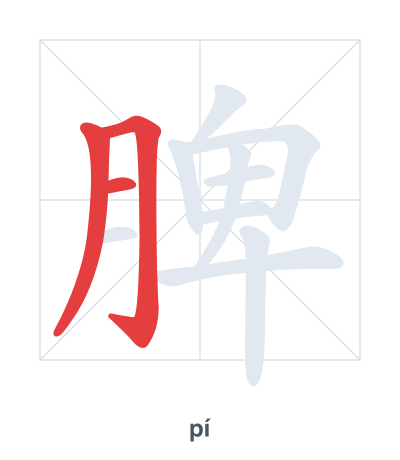
Open Hanzi Writer to see the animated stroke order and practice writing 脾 with real-time feedback.
The character 脾 (pí) is written with 12 strokes. Follow the standard Chinese stroke order: top to bottom, left to right, outside before inside. The radical ⺼ is one of its key components.
Practice the correct stroke order with the Hanzi Writer app to see animated stroke-by-stroke guidance with real-time feedback.
脾 means spleen.
As an HSK Level 5 character, 脾 is an intermediate-level character.
It is a compound character with the radical ⺼ (flesh/meat) indicating a body part, and the component 卑 (bēi, meaning humble or low) serving as a phonetic hint while also suggesting the spleen's lower position in the abdomen. Together, they form the character for 'spleen'.
💡 Memory Tip: Picture a fleshy organ (⺼) that is 'humble' (卑) because it stays low and hidden under the ribs—that's your spleen.
他的脾气很好。
tā de pí qì hěn hǎo
He has a good temper.
别对他发脾气。
bié duì tā fā pí qì
Don't lose your temper with him.
他的脾胃不太好。
tā de pí wèi bù tài hǎo
His digestion is not very good.
Open Hanzi Writer to see the animated stroke order and practice writing 脾 with real-time feedback.
✨ Animated stroke order · Handwriting recognition · HSK-graded practice · Free to use
The character 脾 is composed of the radical ⺼ (flesh/meat) on the left and 卑 (humble) on the right. The left radical shows that it is a body part, while the right side provides the pronunciation and hints at the spleen's "humble" role in the body. Together they form the word for "spleen" in Chinese.