脑 (nǎo) means "brain" in Chinese. It has 10 strokes with the radical 月, and is HSK Level 1.
Rated 3.7/5 in difficulty (challenging).
Harder than 96% of HSK Level 1 characters.
Appears in 3+ common words including 电脑 (diàn nǎo), 头脑 (tóu nǎo), 脑子 (nǎo zi).
Due to its 10 strokes, Hanzi Writer's error detection shows 脑 requires focused practice — most learners need 10+ attempts for consistent accuracy.
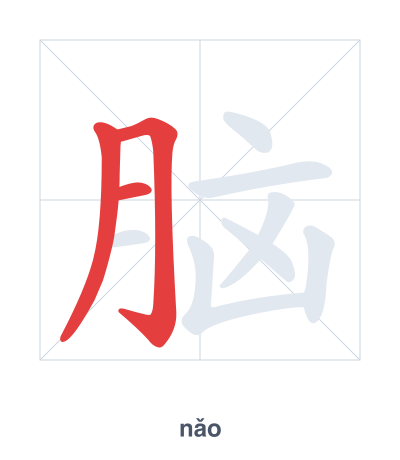
Open Hanzi Writer to see the animated stroke order and practice writing 脑 with real-time feedback.
The character 脑 (nǎo) is written with 10 strokes. Follow the standard Chinese stroke order: top to bottom, left to right, outside before inside. The radical 月 is one of its key components.
Practice the correct stroke order with the Hanzi Writer app to see animated stroke-by-stroke guidance with real-time feedback.
脑 means brain.
As an HSK Level 1 character, 脑 is among the first characters beginners learn.
The character 脑 combines the flesh radical 月 (indicating a body part) with the component 㐫, which originally depicted the wrinkled folds of the brain inside the skull. This structure visually represents the brain as a fleshy, convoluted organ.
💡 Memory Tip: Picture the left side 月 as a slab of meat and the right side 㐫 as a skull with two eye sockets and a nose — together they form your brain inside the head.
我买了一台新电脑。
wǒ mǎi le yī tái xīn diàn nǎo
I bought a new computer.
他的头脑很灵活。
tā de tóu nǎo hěn líng huó
He has a very flexible and quick mind.
动动你的脑子。
dòng dòng nǐ de nǎo zi
Use your brain.
Open Hanzi Writer to see the animated stroke order and practice writing 脑 with real-time feedback.
✨ Animated stroke order · Handwriting recognition · HSK-graded practice · Free to use
脑 uses the radical 月 (flesh/body part) on the left, which shows it relates to a body organ. The right part 匘 (nǎo) gives the pronunciation. Together, the flesh radical plus the phonetic component create the meaning 'brain'.