强 (jiàng/qiáng/qiǎng) means "Strong, powerful" in Chinese. It has 12 strokes with the radical 弓, and is HSK Level 3.
Rated 4.2/5 in difficulty (advanced).
Harder than 75% of HSK Level 3 characters.
Appears in 5+ common words including 强大 (qiáng dà), 强烈 (qiáng liè), 勉强 (miǎn qiǎng).
Due to its 12 strokes, Hanzi Writer's error detection shows 强 requires focused practice — most learners need 10+ attempts for consistent accuracy.
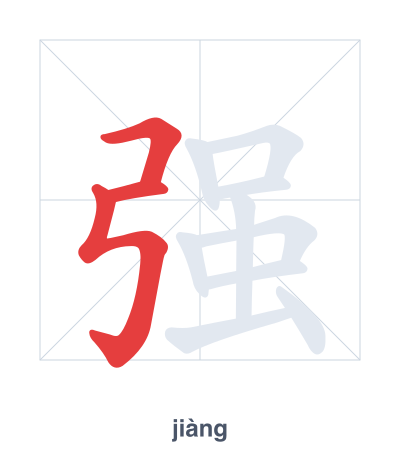
Open Hanzi Writer to see the animated stroke order and practice writing 强 with real-time feedback.
The character 强 (jiàng/qiáng/qiǎng) is written with 12 strokes. Follow the standard Chinese stroke order: top to bottom, left to right, outside before inside. The radical 弓 is one of its key components.
Practice the correct stroke order with the Hanzi Writer app to see animated stroke-by-stroke guidance with real-time feedback.
强 means Strong, powerful.
This is a polyphonic character with readings: jiàng, qiáng, qiǎng.
As an HSK Level 3 character, 强 is an intermediate-level character.
The character 强 combines the radical 弓 (bow), representing strength and archery, with a phonetic component 虽 (originally a simplified form of 畺, meaning 'border' or 'strong'). The bow was a symbol of power in ancient China, so the character visually conveys the idea of being strong or powerful.
💡 Memory Tip: Imagine a muscular archer pulling a bow (弓) so hard that the string snaps, showing incredible strength.
中国正变得日益强大和繁荣。
zhōng guó zhèng biàn dé rì yì qiáng dà hé fán róng
China is becoming increasingly powerful and prosperous.
这种化学品散发出一种强烈的气味。
zhè zhǒng huà xué pǐn sàn fà chū yī zhǒng qiáng liè de qì wèi
This chemical emits a strong odor.
既然他不想参加,就不要勉强他了。
jì rán tā bù xiǎng cān jiā jiù bú yào miǎn qiǎng tā le
Since he doesn't want to participate, don't force him.
我们不能强迫别人接受自己的观点。
wǒ men bù néng qiǎng pò bié rén jiē shòu zì jǐ de guān diǎn
We cannot force others to accept our views.
Open Hanzi Writer to see the animated stroke order and practice writing 强 with real-time feedback.
✨ Animated stroke order · Handwriting recognition · HSK-graded practice · Free to use
The character 强 has the radical 弓 (bow) on the left, suggesting a weapon, and the right side 虽 (although) is a phonetic component. The bow represents strength or force, so 强 combines a tool of power with a sound hint to mean "strong" or "powerful."