佬 (lǎo) means "Fellow / Guy" in Chinese. It has 8 strokes with the radical 亻.
Rated 3.4/5 in difficulty (challenging).
Appears in 3+ common words including 阔佬 (kuò lǎo), 傻佬 (shǎ lǎo), 鬼佬 (guǐ lǎo).
Due to its 8 strokes, Hanzi Writer's error detection shows 佬 requires focused practice — most learners need 10+ attempts for consistent accuracy.
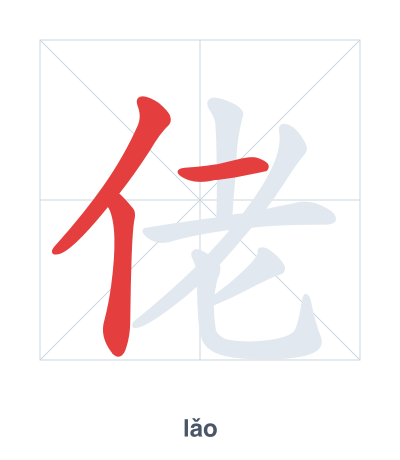
Open Hanzi Writer to see the animated stroke order and practice writing 佬 with real-time feedback.
The character 佬 (lǎo) is written with 8 strokes. Follow the standard Chinese stroke order: top to bottom, left to right, outside before inside. The radical 亻 is one of its key components.
Practice the correct stroke order with the Hanzi Writer app to see animated stroke-by-stroke guidance with real-time feedback.
佬 means Fellow / Guy.
佬 combines the person radical (亻) with 老 (old), which originally depicts an elderly person with a bent back and cane. This indicates an old man or elder, and later extended colloquially to mean 'fellow' or 'guy.'
💡 Memory Tip: Picture an old man (老) leaning on a person (亻) for support, calling him 'old fellow.'
他是个大阔佬。
tā shì gè dà kuò lǎo
He is a wealthy man.
别理那个傻佬。
bié lǐ nà ge shǎ lǎo
Ignore that fool.
那个鬼佬会说中文。
nà ge guǐ lǎo huì shuō zhōng wén
That foreigner can speak Chinese.
Open Hanzi Writer to see the animated stroke order and practice writing 佬 with real-time feedback.
✨ Animated stroke order · Handwriting recognition · HSK-graded practice · Free to use
佬 is made of the radical 亻 (person) on the left and 老 (old) on the right. The left part shows it relates to a person, while the right part hints at meaning like "old" or "veteran," but combined it refers to a fellow or guy. It is not about age but about an informal way to address a man.