悔 (huǐ) means "regret" in Chinese. It has 10 strokes with the radical 忄, and is HSK Level 5.
Rated 4.2/5 in difficulty (advanced).
Harder than 66% of HSK Level 5 characters.
Appears in 3+ common words including 后悔 (hòu huǐ), 悔改 (huǐ gǎi), 悔恨 (huǐ hèn).
Due to its 10 strokes, Hanzi Writer's error detection shows 悔 requires focused practice — most learners need 10+ attempts for consistent accuracy.
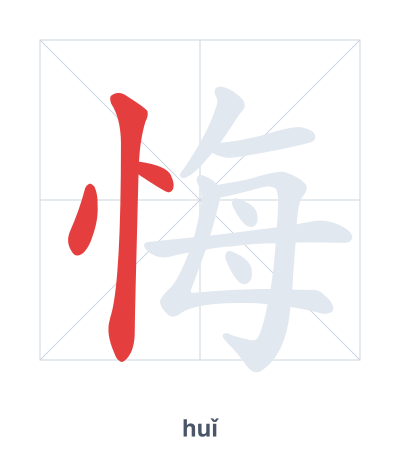
Open Hanzi Writer to see the animated stroke order and practice writing 悔 with real-time feedback.
The character 悔 (huǐ) is written with 10 strokes. Follow the standard Chinese stroke order: top to bottom, left to right, outside before inside. The radical 忄 is one of its key components.
Practice the correct stroke order with the Hanzi Writer app to see animated stroke-by-stroke guidance with real-time feedback.
悔 means regret.
As an HSK Level 5 character, 悔 is an intermediate-level character.
悔 is a compound character formed from the radical 忄 (heart) and 每 (every/each). The heart radical signifies emotion, while 每 suggests the idea of 'every time' – together they convey the feeling of regret that arises each time you reflect on a past action.
💡 Memory Tip: Imagine your heart (忄) feels heavy every time (每) you think of that mistake, and you say 'Hui, why did I do that?'
我现在很后悔。
wǒ xiàn zài hěn hòu huǐ
I regret it very much now.
他决定重新悔改。
tā jué dìng chóng xīn huǐ gǎi
He decided to repent.
他心中充满悔恨。
tā xīn zhōng chōng mǎn huǐ hèn
His heart was full of remorse.
Open Hanzi Writer to see the animated stroke order and practice writing 悔 with real-time feedback.
✨ Animated stroke order · Handwriting recognition · HSK-graded practice · Free to use
悔 is made of the radical 忄 (heart) on the left and 每 (every) on the right. The heart radical indicates that regret is an emotion felt in the heart. Together, they suggest the idea of 'every part of the heart feeling regret.'