改 (gǎi) means "to change; to correct" in Chinese. It has 7 strokes with the radical 攵, and is HSK Level 2.
Rated 2.9/5 in difficulty (moderate).
Harder than 39% of HSK Level 2 characters.
Appears in 3+ common words including 改变 (gǎi biàn), 改正 (gǎi zhèng), 修改 (xiū gǎi).
Hanzi Writer's stroke validation shows learners typically need 5-8 attempts to write 改 with correct proportion and order.
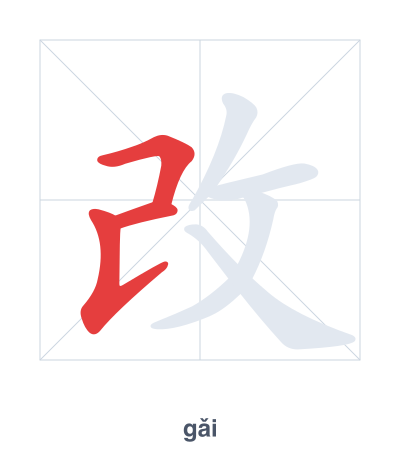
Open Hanzi Writer to see the animated stroke order and practice writing 改 with real-time feedback.
The character 改 (gǎi) is written with 7 strokes. Follow the standard Chinese stroke order: top to bottom, left to right, outside before inside. The radical 攵 is one of its key components.
Practice the correct stroke order with the Hanzi Writer app to see animated stroke-by-stroke guidance with real-time feedback.
改 means to change; to correct.
As an HSK Level 2 character, 改 is among the first characters beginners learn.
改 combines 己 (self) and 攵 (hand holding a stick), originally showing a hand correcting a kneeling person with a rod—meaning to change or correct one's actions.
💡 Memory Tip: Imagine taking a stick (攵) to beat your own coiled self (己) into a new shape, forcing a change.
环境改变了。
huán jìng gǎi biàn le
The environment has changed.
请改正这个错误。
qǐng gǎi zhèng zhè ge cuò wù
Please correct this mistake.
我要修改作业。
wǒ yào xiū gǎi zuò yè
I need to revise my homework.
Open Hanzi Writer to see the animated stroke order and practice writing 改 with real-time feedback.
✨ Animated stroke order · Handwriting recognition · HSK-graded practice · Free to use
改 is made of two parts: the left side 己 (self) and the right side 攵 (a hand holding a stick, meaning action). Together they suggest taking action on yourself to change or correct something.