忙 (máng) means "Busy" in Chinese. It has 6 strokes with the radical 忄, and is HSK Level 1.
Rated 2.7/5 in difficulty (moderate).
Harder than 44% of HSK Level 1 characters.
Appears in 3+ common words including 忙 (máng), 很忙 (hěn máng), 忙碌 (máng lù).
Hanzi Writer's stroke validation shows learners typically need 5-8 attempts to write 忙 with correct proportion and order.
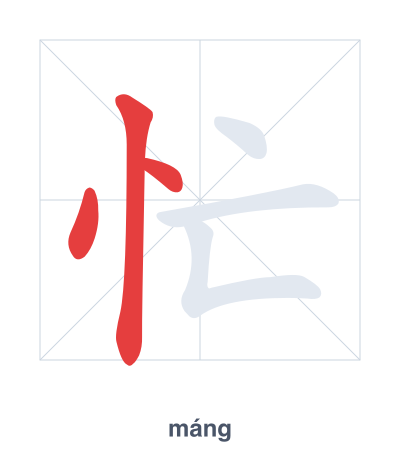
Open Hanzi Writer to see the animated stroke order and practice writing 忙 with real-time feedback.
The character 忙 (máng) is written with 6 strokes. Follow the standard Chinese stroke order: top to bottom, left to right, outside before inside. The radical 忄 is one of its key components.
Practice the correct stroke order with the Hanzi Writer app to see animated stroke-by-stroke guidance with real-time feedback.
忙 means Busy.
As an HSK Level 1 character, 忙 is among the first characters beginners learn.
忙 combines the heart radical (忄), representing the mind or emotions, with 亡 (wáng, 'to lose' or 'perish'). The compound suggests a state where one's mind is lost or overwhelmed, as when extremely busy.
💡 Memory Tip: Picture your heart (忄) feeling like it's dying (亡) from all the endless tasks—that's being busy.
临近年底,公司的每个人都感到非常忙。
lín jìn nián dǐ , gōng sī de měi gè rén dōu gǎn dào fēi cháng máng 。
As the end of the year approaches, everyone in the company feels very busy.
我今天真的很忙。
wǒ jīn tiān zhēn de hěn máng
I'm really busy today.
他的生活很忙碌。
tā de shēng huó hěn máng lù
His life is very busy.
Open Hanzi Writer to see the animated stroke order and practice writing 忙 with real-time feedback.
✨ Animated stroke order · Handwriting recognition · HSK-graded practice · Free to use
忙 is made of two parts: the radical 忄 (heart) on the left, and 亡 (lost or die) on the right. The heart radical suggests a mental or emotional state, and 亡 implies being 'lost' in tasks, so together they convey a feeling of being fully occupied – busy.