后 (hòu) means "behind; after; queen" in Chinese. It has 6 strokes with the radical 口, and is HSK Level 1.
Rated 2.7/5 in difficulty (moderate).
Harder than 40% of HSK Level 1 characters.
Appears in 3+ common words including 后面 (hòu miàn), 以后 (yǐ hòu), 最后 (zuì hòu).
Hanzi Writer's stroke validation shows learners typically need 5-8 attempts to write 后 with correct proportion and order.
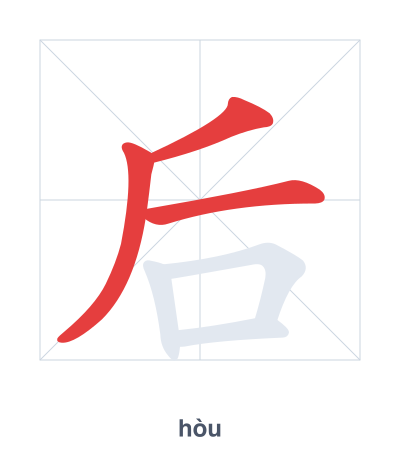
Open Hanzi Writer to see the animated stroke order and practice writing 后 with real-time feedback.
The character 后 (hòu) is written with 6 strokes. Follow the standard Chinese stroke order: top to bottom, left to right, outside before inside. The radical 口 is one of its key components.
Practice the correct stroke order with the Hanzi Writer app to see animated stroke-by-stroke guidance with real-time feedback.
后 means behind; after; queen.
As an HSK Level 1 character, 后 is among the first characters beginners learn.
The character 后 originally depicted a person (or hand) giving commands through a mouth (口), symbolizing a ruler or sovereign. Over time, it was borrowed to mean 'queen' and also simplified from the character 後 to represent 'behind' and 'after'.
💡 Memory Tip: Picture a queen (后) with her mouth (口) wide open, shouting orders from behind her throne.
车站就在学校后面。
chē zhàn jiù zài xué xiào hòu miàn
The station is right behind the school.
我以后想去中国。
wǒ yǐ hòu xiǎng qù zhōng guó
I want to go to China in the future.
这是最后一次机会。
zhè shì zuì hòu yī cì jī huì
This is the last chance.
Open Hanzi Writer to see the animated stroke order and practice writing 后 with real-time feedback.
✨ Animated stroke order · Handwriting recognition · HSK-graded practice · Free to use
后 is composed of a horizontal stroke on top and 口 (mouth, kǒu) below. The top part originally represented a flag or a symbol of authority, and combined with 口 it suggested a ruler giving orders, which led to the meaning 'queen'. Later, the character was also used phonetically for the sense of 'behind' and 'after', but its structure does not directly show that meaning.