怏 (yàng) means "discontented; unhappy" in Chinese. It has 8 strokes with the radical 忄.
Rated 3.7/5 in difficulty (challenging).
Appears in 3+ common words including 怏怏不乐 (yàng yàng bù lè), 怏怏 (yàng yàng), 怏然 (yàng rán).
Due to its 8 strokes, Hanzi Writer's error detection shows 怏 requires focused practice — most learners need 10+ attempts for consistent accuracy.
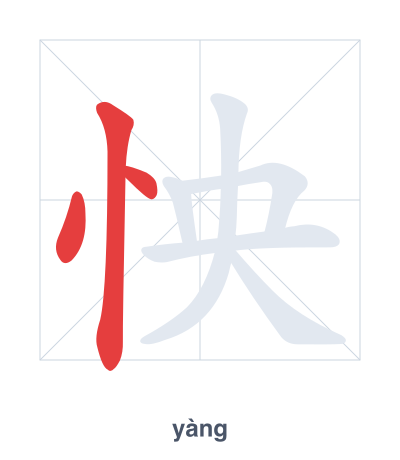
Open Hanzi Writer to see the animated stroke order and practice writing 怏 with real-time feedback.
The character 怏 (yàng) is written with 8 strokes. Follow the standard Chinese stroke order: top to bottom, left to right, outside before inside. The radical 忄 is one of its key components.
Practice the correct stroke order with the Hanzi Writer app to see animated stroke-by-stroke guidance with real-time feedback.
怏 means discontented; unhappy.
怏 is a phono-semantic compound. The left radical 忄 (heart) conveys emotion, while the right component 央 (yāng, meaning 'center' or 'middle') provides the sound and adds the idea of being stuck in the middle—like a stifled feeling that leads to discontent or unhappiness.
💡 Memory Tip: Picture a heart (忄) trapped in the center (央) of a cramped room, sulking because it can't escape—utterly unhappy.
他整天怏怏不乐。
tā zhěng tiān yàng yàng bù lè
He is unhappy and discontented all day long.
他怏怏地离开了。
tā yàng yàng dì lí kāi le
He left dejectedly.
他怏然不悦。
tā yàng rán bú yuè
He looked displeased.
Open Hanzi Writer to see the animated stroke order and practice writing 怏 with real-time feedback.
✨ Animated stroke order · Handwriting recognition · HSK-graded practice · Free to use
The left side is the radical 忄, which means 'heart' or 'mind'. The right side is 央 (yāng, 'center' or 'entreat'). Together, the character suggests a feeling in the heart that is stuck or not satisfied, leading to discontentment.