怊 (chāo) means "sad; disappointed" in Chinese. It has 8 strokes with the radical 忄.
Rated 3.7/5 in difficulty (challenging).
Appears in 3+ common words including 怊怅 (chāo chàng), 怊然 (chāo rán), 怊怊 (chāo chāo).
Due to its 8 strokes, Hanzi Writer's error detection shows 怊 requires focused practice — most learners need 10+ attempts for consistent accuracy.
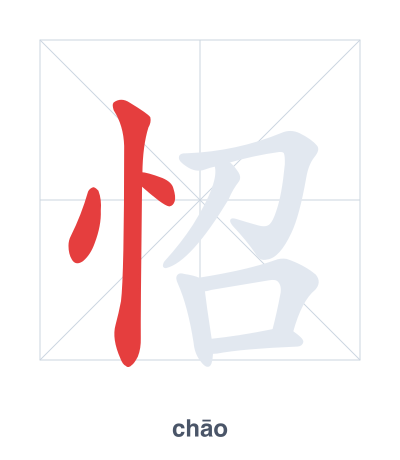
Open Hanzi Writer to see the animated stroke order and practice writing 怊 with real-time feedback.
The character 怊 (chāo) is written with 8 strokes. Follow the standard Chinese stroke order: top to bottom, left to right, outside before inside. The radical 忄 is one of its key components.
Practice the correct stroke order with the Hanzi Writer app to see animated stroke-by-stroke guidance with real-time feedback.
怊 means sad; disappointed.
怊 is a compound character with the heart radical 忄 (忄) on the left and the phonetic component 召 (zhào, meaning 'summon' or 'call') on the right. The heart radical indicates an emotion, and the phonetic hints at the sound; together they suggest a heart that is 'called' to sadness—feeling summoned or beckoned into disappointment.
💡 Memory Tip: Imagine your heart (忄) being called (召) by a sad trumpet sound—every time it blows, you feel disappointed and blue.
他心里感到很怊怅。
tā xīn lǐ gǎn dào hěn chāo chàng
He feels very disappointed and sorrowful.
他怊然长叹一声。
tā chāo rán cháng tàn yī shēng
He gave a deep sigh of disappointment.
他的神情怊怊的。
tā de shén qíng chāo chāo de
His expression is very disappointed.
Open Hanzi Writer to see the animated stroke order and practice writing 怊 with real-time feedback.
✨ Animated stroke order · Handwriting recognition · HSK-graded practice · Free to use
The character 怊 is made of two parts: the radical 忄 on the left and the phonetic component 召 on the right. 忄 means 'heart' or 'emotion', so the character relates to feelings, while 召 provides the pronunciation chāo and adds a sense of 'summoning'—together they suggest a heart that is 'summoning sadness' or feeling disappointed.