呼 (hū) means "to exhale / to call / to shout" in Chinese. It has 8 strokes with the radical 口, and is HSK Level 4.
Rated 3.7/5 in difficulty (challenging).
Harder than 40% of HSK Level 4 characters.
Appears in 3+ common words including 呼吸 (hū xī), 欢呼 (huān hū), 招呼 (zhāo hū).
Due to its 8 strokes, Hanzi Writer's error detection shows 呼 requires focused practice — most learners need 10+ attempts for consistent accuracy.
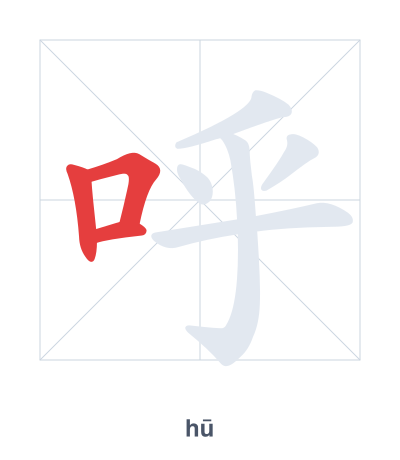
Open Hanzi Writer to see the animated stroke order and practice writing 呼 with real-time feedback.
The character 呼 (hū) is written with 8 strokes. Follow the standard Chinese stroke order: top to bottom, left to right, outside before inside. The radical 口 is one of its key components.
Practice the correct stroke order with the Hanzi Writer app to see animated stroke-by-stroke guidance with real-time feedback.
呼 means to exhale / to call / to shout.
As an HSK Level 4 character, 呼 is an intermediate-level character.
呼 combines the mouth radical (口) with 乎 (hū), which serves as a phonetic component and originally depicted a call or exhalation. Together, they represent actions of the mouth such as exhaling, shouting, or calling out.
💡 Memory Tip: Imagine a mouth (口) blowing out a puff of air (the 乎 shape) as it shouts or exhales.
这里的空气很好,多呼吸。
zhè lǐ de kōng qì hěn hǎo duō hū xī
The air here is very good; breathe deeply.
大家为胜利欢呼。
dà jiā wèi shèng lì huān hū
Everyone cheered for the victory.
他主动跟我打招呼。
tā zhǔ dòng gēn wǒ dǎ zhāo hū
He took the initiative to greet me.
Open Hanzi Writer to see the animated stroke order and practice writing 呼 with real-time feedback.
✨ Animated stroke order · Handwriting recognition · HSK-graded practice · Free to use
呼 is composed of the radical 口 (mouth) on the left and 乎 (hū) on the right. The mouth radical directly links to actions like exhaling, calling, or shouting. The component 乎 provides the sound and also carries a sense of calling out, together forming the character's core meanings.