吂 (máng) means "ignorant; unaware" in Chinese. It has 6 strokes with the radical 口.
Rated 3.2/5 in difficulty (challenging).
Appears in 3+ common words including 吂不知 (máng bù zhī), 吂然 (máng rán), 吂吂 (máng máng).
Due to its 6 strokes, Hanzi Writer's error detection shows 吂 requires focused practice — most learners need 10+ attempts for consistent accuracy.
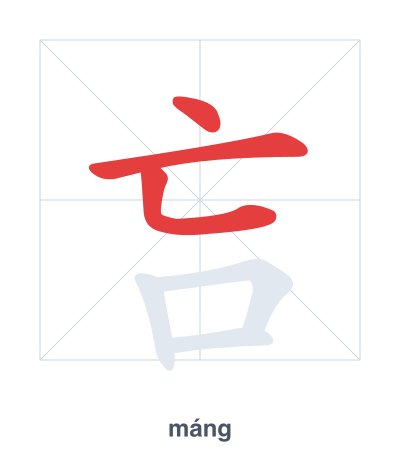
Open Hanzi Writer to see the animated stroke order and practice writing 吂 with real-time feedback.
The character 吂 (máng) is written with 6 strokes. Follow the standard Chinese stroke order: top to bottom, left to right, outside before inside. The radical 口 is one of its key components.
Practice the correct stroke order with the Hanzi Writer app to see animated stroke-by-stroke guidance with real-time feedback.
吂 means ignorant; unaware.
The character 吂 combines the radical 口 (mouth) with 亡 (death/lost), literally depicting a 'dead mouth' — one that cannot speak or hear, thus implying ignorance or unawareness of knowledge. Historically, it appears in compounds like 盲 (blind) where 亡 adds a sense of 'lack', so 吂 suggests a lack of verbal or sensory awareness.
💡 Memory Tip: Imagine a mouth (口) that is dead (亡) — it can't taste, speak, or learn, so it remains blissfully ignorant.
他对此事吂不知情。
tā duì cǐ shì máng bù zhī qíng
He is completely unaware of this matter.
他听后一脸吂然。
tā tīng hòu yī liǎn máng rán
He looked completely bewildered after hearing it.
前途一片吂吂。
qián tú yī piàn máng máng
The future is hazy and uncertain.
Open Hanzi Writer to see the animated stroke order and practice writing 吂 with real-time feedback.
✨ Animated stroke order · Handwriting recognition · HSK-graded practice · Free to use
吂 is a compound character made of the radical 口 (mouth) on top and the phonetic component 亡 (wáng, meaning 'death' or 'lost') below. The mouth radical suggests speech or expression, while 亡 hints at something lost or absent, together implying a lack of knowledge or awareness.