符 (fú) means "symbol or charm" in Chinese. It has 11 strokes with the radical 竹, and is HSK Level 4.
Rated 4.2/5 in difficulty (advanced).
Harder than 84% of HSK Level 4 characters.
Appears in 3+ common words including 符合 (fú hé), 符号 (fú hào), 护身符 (hù shēn fú).
Due to its 11 strokes, Hanzi Writer's error detection shows 符 requires focused practice — most learners need 10+ attempts for consistent accuracy.
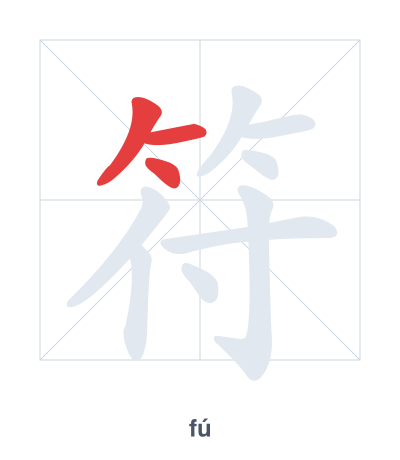
Open Hanzi Writer to see the animated stroke order and practice writing 符 with real-time feedback.
The character 符 (fú) is written with 11 strokes. Follow the standard Chinese stroke order: top to bottom, left to right, outside before inside. The radical 竹 is one of its key components.
Practice the correct stroke order with the Hanzi Writer app to see animated stroke-by-stroke guidance with real-time feedback.
符 means symbol or charm.
As an HSK Level 4 character, 符 is an intermediate-level character.
符 combines the radical 竹 (bamboo) and the component 付 (to give/attach). In ancient China, bamboo tallies were split in half as contracts or symbols of authority; matching the halves verified identity or conveyed orders—thus the character came to mean a symbol or charm.
💡 Memory Tip: Picture a bamboo stalk (竹) with a charm attached (付) that you give to someone as a secret sign.
这不符合要求。
zhè bù fú hé yāo qiú
This does not meet the requirements.
这是什么符号?
zhè shì shén me fú hào
What symbol is this?
他戴着护身符。
tā dài zhe hù shēn fú
He is wearing an amulet.
Open Hanzi Writer to see the animated stroke order and practice writing 符 with real-time feedback.
✨ Animated stroke order · Handwriting recognition · HSK-graded practice · Free to use
符 is made of the radical 竹 (bamboo) on top and 付 (fù, to hand over) below. Bamboo was traditionally used for writing charms and talismans, and 付 suggests the action of giving or attaching, so together they form the idea of a written charm or symbol that is handed over.