竿 (gān) means "Pole or rod" in Chinese. It has 9 strokes with the radical 竹, and is HSK Level 7.
Rated 4/5 in difficulty (challenging).
Harder than 44% of HSK Level 7 characters.
Appears in 3+ common words including 鱼竿 (yú gān), 竹竿 (zhú gān), 撑竿跳 (chēng gān tiào).
Due to its 9 strokes, Hanzi Writer's error detection shows 竿 requires focused practice — most learners need 10+ attempts for consistent accuracy.
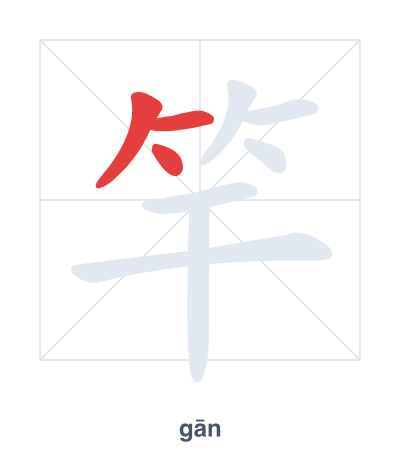
Open Hanzi Writer to see the animated stroke order and practice writing 竿 with real-time feedback.
The character 竿 (gān) is written with 9 strokes. Follow the standard Chinese stroke order: top to bottom, left to right, outside before inside. The radical 竹 is one of its key components.
Practice the correct stroke order with the Hanzi Writer app to see animated stroke-by-stroke guidance with real-time feedback.
竿 means Pole or rod.
As an HSK Level 7 character, 竿 is an intermediate-level character.
竿 combines the radical 竹 (bamboo) with 干 (pole/shaft). Bamboo is the material, while 干 contributes the meaning of a long straight object, together forming a 'bamboo pole or rod.'
💡 Memory Tip: Imagine a bamboo stalk (竹) holding up a long, straight drying stick (干) — that's your rod.
我买了一个鱼竿。
wǒ mǎi le yí gè yú gān
I bought a fishing rod.
他拿着一根竹竿。
tā ná zhe yī gēn zhú gān
He was holding a bamboo pole.
他喜欢撑竿跳。
tā xǐ huān chēng gān tiào
He likes pole vaulting.
Open Hanzi Writer to see the animated stroke order and practice writing 竿 with real-time feedback.
✨ Animated stroke order · Handwriting recognition · HSK-graded practice · Free to use
竿 is formed with the radical 竹 (bamboo) on top and 干 (gān) below. The bamboo radical shows that poles were traditionally made of bamboo, and 干 gives the sound and also suggests a long straight shaft.