笄 (jī) means "Hairpin" in Chinese. It has 10 strokes with the radical 竹.
Rated 4.2/5 in difficulty (advanced).
Appears in 3+ common words including 笄礼 (jī lǐ), 发笄 (fā jī), 笄年 (jī nián).
Due to its 10 strokes, Hanzi Writer's error detection shows 笄 requires focused practice — most learners need 10+ attempts for consistent accuracy.
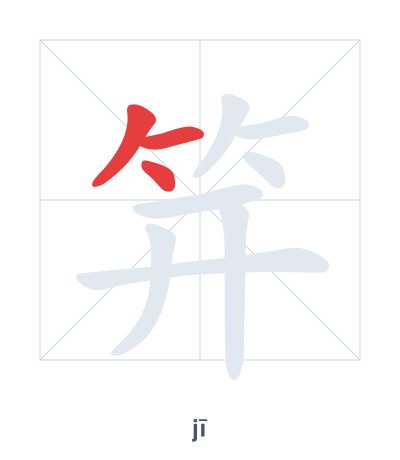
Open Hanzi Writer to see the animated stroke order and practice writing 笄 with real-time feedback.
The character 笄 (jī) is written with 10 strokes. Follow the standard Chinese stroke order: top to bottom, left to right, outside before inside. The radical 竹 is one of its key components.
Practice the correct stroke order with the Hanzi Writer app to see animated stroke-by-stroke guidance with real-time feedback.
笄 means Hairpin.
笄 combines the radical 竹 (bamboo, the material) with 幵 (two parallel lines), which graphically represents the shape of a hairpin with two prongs. In ancient China, hairpins were essential for securing hairstyles and were often made of bamboo or bone.
💡 Memory Tip: Imagine a bamboo (竹) hairpin with two parallel prongs (幵) sliding smoothly into a coiled bun.
她参加了笄礼。
tā cān jiā le jī lǐ
She participated in the hair-pinning ceremony (traditional coming-of-age).
她戴着一个发笄。
tā dài zhe yí gè fā jī
She wore a traditional hairpin.
她正值笄年。
tā zhèng zhí jī nián
She is at the age of fifteen.
Open Hanzi Writer to see the animated stroke order and practice writing 笄 with real-time feedback.
✨ Animated stroke order · Handwriting recognition · HSK-graded practice · Free to use
笄 is made of two parts: the radical 竹 (bamboo) on top, and the phonetic component 开 (kāi, to open) below. The bamboo radical suggests that ancient hairpins were often made of bamboo. The component 开 adds a rough sound hint, though its meaning doesn't directly contribute to the hairpin concept.