合 (hé) means "To close / To join / To suit." in Chinese. It has 6 strokes with the radical 口, and is HSK Level 2.
Rated 2.7/5 in difficulty (moderate).
Harder than 27% of HSK Level 2 characters.
Appears in 3+ common words including 合作 (hé zuò), 合理 (hé lǐ), 一合 (yī hé).
Hanzi Writer's stroke validation shows learners typically need 5-8 attempts to write 合 with correct proportion and order.
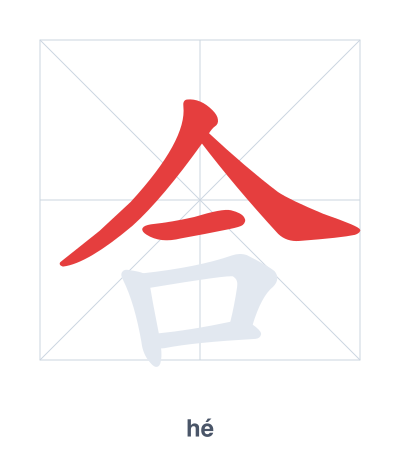
Open Hanzi Writer to see the animated stroke order and practice writing 合 with real-time feedback.
The character 合 (hé) is written with 6 strokes. Follow the standard Chinese stroke order: top to bottom, left to right, outside before inside. The radical 口 is one of its key components.
Practice the correct stroke order with the Hanzi Writer app to see animated stroke-by-stroke guidance with real-time feedback.
合 means To close / To join / To suit..
As an HSK Level 2 character, 合 is among the first characters beginners learn.
合 is a compound of 亼 (a lid or cover) and 口 (mouth), depicting a lid covering a container or a mouth being closed, which conveys the meanings of 'to close' and 'to join.' Its ancient form shows two parts coming together, emphasizing union or fitting.
💡 Memory Tip: Picture a lid (亼) snapping shut over a mouth (口) to "close" or "join" them perfectly.
只有精诚合作,我们才能战胜眼前的困难。
zhǐ yǒu jīng chéng hé zuò wǒ men cái néng zhàn shèng yǎn qián de kùn nán
Only through sincere cooperation can we overcome the current difficulties.
这个方案制定的非常合理,大家都赞同。
zhè ge fāng àn zhì dìng de fēi cháng hé lǐ dà jiā dōu zàn tóng
This plan is very reasonably formulated, and everyone agrees with it.
在古代,一合是一种专门用于称量粮食的容量。
zài gǔ dài yī hé shì yī zhǒng zhuān mén yòng yú chēng liáng liáng shí de róng liàng
In ancient times, a 'ge' was a unit of capacity specifically used for measuring grain.
Open Hanzi Writer to see the animated stroke order and practice writing 合 with real-time feedback.
✨ Animated stroke order · Handwriting recognition · HSK-graded practice · Free to use
合 is composed of a top part that looks like a lid (亼, a variant of 人 meaning 'person' or 'cover') and the radical 口 (mouth) below. Together, they suggest a lid covering a mouth, which relates to meanings like 'to close', 'to join', or 'to suit'.