身 (shēn) means "body; oneself; personally" in Chinese. It has 7 strokes with the radical 身, and is HSK Level 1.
Rated 2.3/5 in difficulty (moderate).
Harder than 26% of HSK Level 1 characters.
Appears in 3+ common words including 身体 (shēn tǐ), 身上 (shēn shàng), 健身 (jiàn shēn).
Hanzi Writer's stroke validation shows learners typically need 5-8 attempts to write 身 with correct proportion and order.
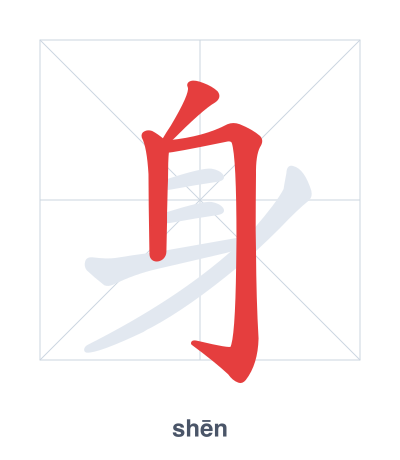
Open Hanzi Writer to see the animated stroke order and practice writing 身 with real-time feedback.
The character 身 (shēn) is written with 7 strokes. Follow the standard Chinese stroke order: top to bottom, left to right, outside before inside. The radical 身 is one of its key components.
Practice the correct stroke order with the Hanzi Writer app to see animated stroke-by-stroke guidance with real-time feedback.
身 means body; oneself; personally.
As an HSK Level 1 character, 身 is among the first characters beginners learn.
The character 身 is a pictograph of a pregnant woman with a prominent belly, representing the body. The ancient form clearly showed a profile of a person with a large abdomen, which evolved into the modern shape with a curved upper part (the torso and belly) and two legs at the bottom. This directly connects to the meaning of 'body' or 'oneself'.
💡 Memory Tip: Imagine a person with a big round belly (the middle part of 身) proudly showing off their body, with legs stretching down below.
你要多注意身体。
nǐ yào duō zhù yì shēn tǐ
You should take more care of your health.
我身上没带钱。
wǒ shēn shàng méi dài qián
I don't have any money on me.
我每天去健身。
wǒ měi tiān qù jiàn shēn
I go to work out every day.
Open Hanzi Writer to see the animated stroke order and practice writing 身 with real-time feedback.
✨ Animated stroke order · Handwriting recognition · HSK-graded practice · Free to use
The character 身 is a pictograph that originally depicted a pregnant woman's side profile, showing the belly and body shape. Over time, it simplified into the current form, but the idea of a physical body remains central. Its radical is itself (身), so it is both the character and the component.