笈 (jí) means "Bamboo box for books" in Chinese. It has 9 strokes with the radical 竹.
Rated 4/5 in difficulty (challenging).
Appears in 3+ common words including 秘笈 (mì jí), 书笈 (shū jí), 笈囊 (jí náng).
Due to its 9 strokes, Hanzi Writer's error detection shows 笈 requires focused practice — most learners need 10+ attempts for consistent accuracy.
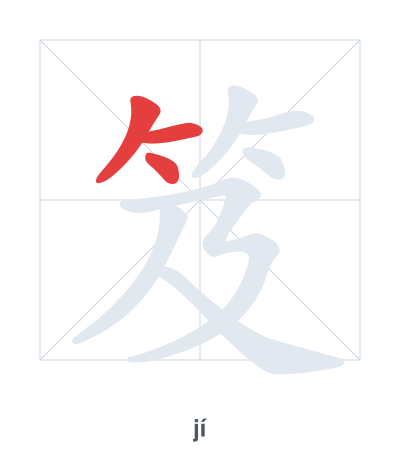
Open Hanzi Writer to see the animated stroke order and practice writing 笈 with real-time feedback.
The character 笈 (jí) is written with 9 strokes. Follow the standard Chinese stroke order: top to bottom, left to right, outside before inside. The radical 竹 is one of its key components.
Practice the correct stroke order with the Hanzi Writer app to see animated stroke-by-stroke guidance with real-time feedback.
笈 means Bamboo box for books.
笈 is a compound character: the radical 竹 (bamboo) shows the material, while 及 (jí, 'to reach') gives the sound and hints at the box's function—reaching to carry books. Ancient scholars used these bamboo boxes to store and transport scrolls, so the character visually blends 'bamboo' with the idea of extending to hold learning.
💡 Memory Tip: Picture a student reaching (及) into a bamboo (竹) box to grab a book—the box itself is the 笈, always ready to share knowledge.
他有一本秘笈。
tā yǒu yī běn mì jí
He has a secret manual.
他背着书笈。
tā bèi zhe shū jí
He is carrying a book chest.
笈囊里装满了书。
jí náng lǐ zhuāng mǎn le shū
The book bag is full of books.
Open Hanzi Writer to see the animated stroke order and practice writing 笈 with real-time feedback.
✨ Animated stroke order · Handwriting recognition · HSK-graded practice · Free to use
The character 笈 is made of two parts: the top radical 竹 (bamboo) and the bottom component 及 (jí). The bamboo radical shows that the character is related to bamboo items, and 及 gives the pronunciation while also suggesting the idea of 'reaching' or 'carrying' books. Together, they form the meaning of a bamboo box or case for storing books.