笋 (sǔn) means "Bamboo shoot" in Chinese. It has 10 strokes with the radical 竹.
Rated 4.2/5 in difficulty (advanced).
Appears in 3+ common words including 竹笋 (zhú sǔn), 春笋 (chūn sǔn), 笋干 (sǔn gān).
Due to its 10 strokes, Hanzi Writer's error detection shows 笋 requires focused practice — most learners need 10+ attempts for consistent accuracy.
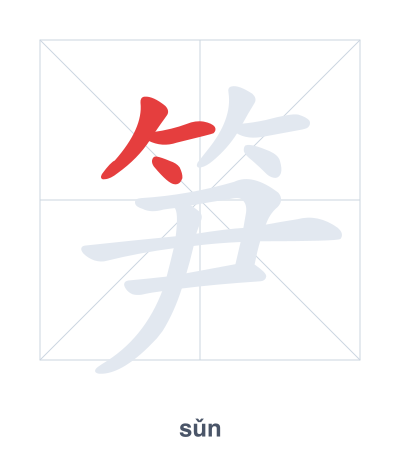
Open Hanzi Writer to see the animated stroke order and practice writing 笋 with real-time feedback.
The character 笋 (sǔn) is written with 10 strokes. Follow the standard Chinese stroke order: top to bottom, left to right, outside before inside. The radical 竹 is one of its key components.
Practice the correct stroke order with the Hanzi Writer app to see animated stroke-by-stroke guidance with real-time feedback.
笋 means Bamboo shoot.
笋 is a compound character combining the radical 竹 (bamboo) with 旬 (xún, a ten-day period). Bamboo shoots grow rapidly, often reaching full height within a month, so the phonetic 旬 hints at their speedy sprouting time.
💡 Memory Tip: Imagine a bamboo shoot (竹) with a tiny calendar showing '10 days' (旬) because it shoots up that fast.
我喜欢吃竹笋。
wǒ xǐ huān chī zhú sǔn
I like eating bamboo shoots.
春笋长得很快。
chūn sǔn zhǎng dé hěn kuài
Spring bamboo shoots grow very fast.
笋干很有嚼劲。
sǔn gān hěn yǒu jué jìn
Dried bamboo shoots are very chewy.
Open Hanzi Writer to see the animated stroke order and practice writing 笋 with real-time feedback.
✨ Animated stroke order · Handwriting recognition · HSK-graded practice · Free to use
The top part is the radical 竹, which means bamboo. The bottom part 尹 originally gave a phonetic hint in the traditional form 筍, but in simplified 笋 it visually suggests a shoot coming out of the ground. Together, they represent a bamboo shoot.