笆 (bā) means "Bamboo fence" in Chinese. It has 10 strokes with the radical 竹.
Rated 4.2/5 in difficulty (advanced).
Appears in 3+ common words including 篱笆 (lí bā), 竹笆 (zhú bā), 笆斗 (bā dǒu).
Due to its 10 strokes, Hanzi Writer's error detection shows 笆 requires focused practice — most learners need 10+ attempts for consistent accuracy.
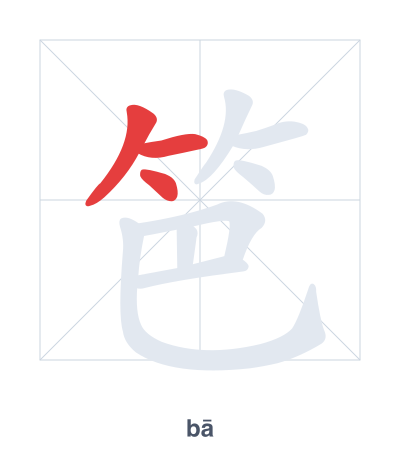
Open Hanzi Writer to see the animated stroke order and practice writing 笆 with real-time feedback.
The character 笆 (bā) is written with 10 strokes. Follow the standard Chinese stroke order: top to bottom, left to right, outside before inside. The radical 竹 is one of its key components.
Practice the correct stroke order with the Hanzi Writer app to see animated stroke-by-stroke guidance with real-time feedback.
笆 means Bamboo fence.
笆 is a compound character with the radical 竹 (bamboo) and the phonetic component 巴 (bā). The bamboo radical indicates the material, while 巴 contributes sound; together they depict a fence woven from bamboo strips.
💡 Memory Tip: Imagine a bamboo fence shaped like a giant 'B' (巴), with the bamboo radical on top showing the material—like a woven barrier made of bamboo stalks.
院子有个篱笆。
yuàn zi yǒu gè lí bā
The yard has a fence.
这是竹笆做的。
zhè shì zhú bā zuò de
This is made of bamboo fencing.
他拿着一个笆斗。
tā ná zhe yí gè bā dǒu
He was holding a wicker basket.
Open Hanzi Writer to see the animated stroke order and practice writing 笆 with real-time feedback.
✨ Animated stroke order · Handwriting recognition · HSK-graded practice · Free to use
笆 is made of two parts: the top radical 竹 (bamboo) and the bottom part 巴. The bamboo radical shows that 笆 is related to bamboo, while 巴 gives the pronunciation bā and links to the idea of something that clings or covers, like a fence. Together, they represent a bamboo fence.