笃 (dǔ) means "Sincere or earnest" in Chinese. It has 9 strokes with the radical 竹.
Rated 4/5 in difficulty (challenging).
Appears in 3+ common words including 笃定 (dǔ dìng), 笃实 (dǔ shí), 笃信 (dǔ xìn).
Due to its 9 strokes, Hanzi Writer's error detection shows 笃 requires focused practice — most learners need 10+ attempts for consistent accuracy.
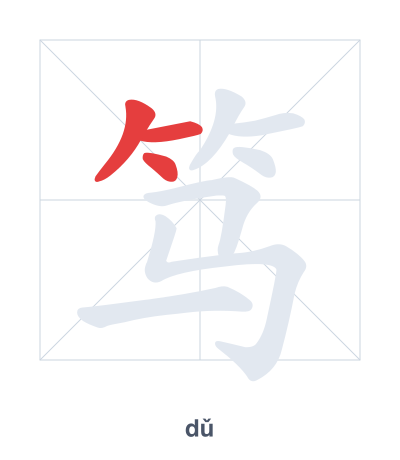
Open Hanzi Writer to see the animated stroke order and practice writing 笃 with real-time feedback.
The character 笃 (dǔ) is written with 9 strokes. Follow the standard Chinese stroke order: top to bottom, left to right, outside before inside. The radical 竹 is one of its key components.
Practice the correct stroke order with the Hanzi Writer app to see animated stroke-by-stroke guidance with real-time feedback.
笃 means Sincere or earnest.
The character 笃 combines bamboo (竹) on top and horse (马) below. Bamboo symbolizes uprightness and resilience, while the horse represents steadiness and loyalty, together conveying the meaning of sincere and earnest.
💡 Memory Tip: Picture a bamboo horse that never runs away, standing faithfully as a symbol of sincere dedication.
他心里很笃定。
tā xīn lǐ hěn dǔ dìng
He feels very certain.
他为人很笃实。
tā wéi rén hěn dǔ shí
He is very honest and sincere.
他笃信这个道理。
tā dǔ xìn zhè ge dào lǐ
He firmly believes in this principle.
Open Hanzi Writer to see the animated stroke order and practice writing 笃 with real-time feedback.
✨ Animated stroke order · Handwriting recognition · HSK-graded practice · Free to use
笃 is composed of two parts: the top is 竹 (bamboo) and the bottom is 马 (horse). Bamboo suggests firmness and stability, while a horse moves steadily, together implying a sincere and earnest character that is both steady and reliable.