号 (háo/hào) means "number, mark, call" in Chinese. It has 5 strokes with the radical 口, and is HSK Level 1.
Rated 2.4/5 in difficulty (moderate).
Harder than 30% of HSK Level 1 characters.
Appears in 4+ common words including 号码 (hào mǎ), 记号 (jì hào), 哀号 (āi háo).
Hanzi Writer's stroke validation shows learners typically need 5-8 attempts to write 号 with correct proportion and order.
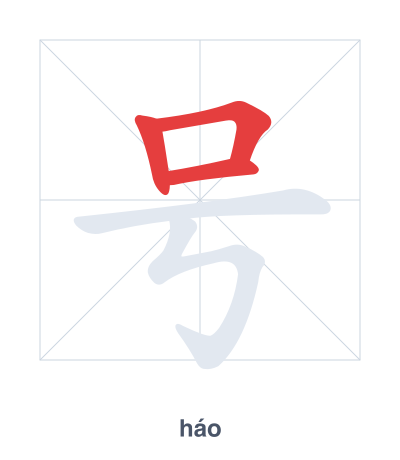
Open Hanzi Writer to see the animated stroke order and practice writing 号 with real-time feedback.
The character 号 (háo/hào) is written with 5 strokes. Follow the standard Chinese stroke order: top to bottom, left to right, outside before inside. The radical 口 is one of its key components.
Practice the correct stroke order with the Hanzi Writer app to see animated stroke-by-stroke guidance with real-time feedback.
号 means number, mark, call.
This is a polyphonic character with readings: háo, hào.
As an HSK Level 1 character, 号 is among the first characters beginners learn.
The character 号 combines the radical 口 (mouth, representing sound or speech) with 丂, an ancient pictograph of a curved horn or wind instrument that produces a loud call. Originally meaning "to roar" or "shout," it later extended to signify a "mark" or "number" used for identification, as in a designated call sign.
💡 Memory Tip: Imagine a mouth (口) blowing a curved horn (丂) to announce someone's number in a loud call.
请记下我办公室的电话号码。
qǐng jì xià wǒ bàn gōng shì de diàn huà hào mǎ
Please write down my office phone number.
他在书上重点的地方做了记号。
tā zài shū shàng zhòng diǎn de dì fāng zuò le jì hào
He made marks on the important parts of the book.
失去亲人的痛苦让他忍不住大声哀号。
shī qù qīn rén de tòng kǔ ràng tā rěn bú zhù dà shēng āi háo
The pain of losing a loved one made him unable to stop wailing loudly.
狂风在冬日的夜晚剧烈怒号。
kuáng fēng zài dōng rì de yè wǎn jù liè nù háo
The gale howled fiercely on the winter night.
Open Hanzi Writer to see the animated stroke order and practice writing 号 with real-time feedback.
✨ Animated stroke order · Handwriting recognition · HSK-graded practice · Free to use
号 is made of two parts: the radical 口 (mouth) on top and a curved stroke 丂 below. The mouth radical suggests calling or shouting, while the bottom part originally represented a curved hook or mark, together giving meanings like 'number' or 'call'.