竺 (zhú) means "India (ancient name) or a surname" in Chinese. It has 8 strokes with the radical 竹.
Rated 3.7/5 in difficulty (challenging).
Appears in 3+ common words including 天竺 (tiān zhú), 竺法 (zhú fǎ), 竺僧 (zhú sēng).
Due to its 8 strokes, Hanzi Writer's error detection shows 竺 requires focused practice — most learners need 10+ attempts for consistent accuracy.
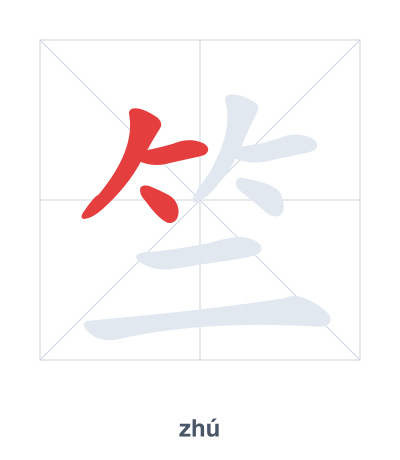
Open Hanzi Writer to see the animated stroke order and practice writing 竺 with real-time feedback.
The character 竺 (zhú) is written with 8 strokes. Follow the standard Chinese stroke order: top to bottom, left to right, outside before inside. The radical 竹 is one of its key components.
Practice the correct stroke order with the Hanzi Writer app to see animated stroke-by-stroke guidance with real-time feedback.
竺 means India (ancient name) or a surname.
竺 combines the radical 竹 (bamboo) above the numeral 二 (two). It was historically borrowed phonetically to write the name of India (天竺, from Sanskrit Sindhu), with the bamboo component perhaps evoking the lush vegetation of the subcontinent.
💡 Memory Tip: Picture two bamboo shoots (竹 over 二) growing side by side, forming a gateway to ancient India.
他去过天竺。
tā qù guò tiān zhú
He has been to India.
竺法非常深奥。
zhú fǎ fēi cháng shēn ào
The Buddhist teachings are very profound.
这里的竺僧很多。
zhè lǐ de zhú sēng hěn duō
There are many Indian monks here.
Open Hanzi Writer to see the animated stroke order and practice writing 竺 with real-time feedback.
✨ Animated stroke order · Handwriting recognition · HSK-graded practice · Free to use
竺 is made of the bamboo radical (⺮) on top and the number two (二) below. The bamboo radical is a phonetic hint from the character's ancient pronunciation, but the meaning 'India' comes from historical usage as a loan word. The bottom part 二 does not directly contribute to the meaning.