Hanzi Writer

How to Write 端 (duān) — Meaning “End; point; upright”

duān HSK Level 6 14 strokes Radical: 立

端 (duān) means "End; point; upright" in Chinese. It has 14 strokes with the radical 立, and is HSK Level 6.

Rated 4.2/5 in difficulty (advanced).

Harder than 82% of HSK Level 6 characters.

Appears in 3+ common words including 端午节 (duān wǔ jié), 端正 (duān zhèng), 终端 (zhōng duān).

Due to its 14 strokes, Hanzi Writer's error detection shows 端 requires focused practice — most learners need 10+ attempts for consistent accuracy.
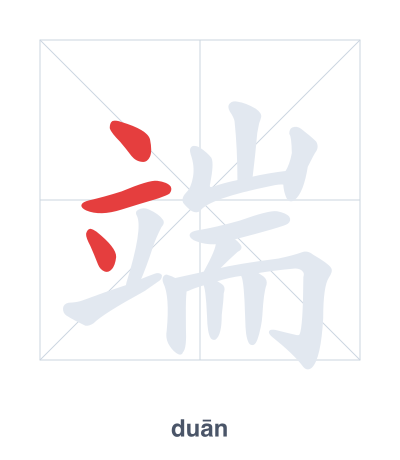
Stroke order practice for 端 - duān

Practice Writing 端 (duān)

Open Hanzi Writer to see the animated stroke order and practice writing 端 with real-time feedback.

The character (duān) is written with 14 strokes. Follow the standard Chinese stroke order: top to bottom, left to right, outside before inside. The radical is one of its key components.

Practice the correct stroke order with the Hanzi Writer app to see animated stroke-by-stroke guidance with real-time feedback.

means End; point; upright.

As an HSK Level 6 character, is an intermediate-level character.

Character
Pinyinduān (duan)
MeaningEnd; point; upright
Strokes14
Radical
HSK Level6
Difficulty4.2/5

端 combines radical 立 (standing upright) with phonetic component 耑, which originally depicted a plant with roots and a sprouting tip, symbolizing an 'end' or 'point'. Together, the character suggests standing straight at the tip or end of something, linking to meanings like 'end', 'point', and 'upright'.

💡 Memory Tip: Picture a person standing (立) upright on the pointed tip (耑) of a mountain, perfectly balanced at the very end.

duān wǔ jié
Dragon Boat Festival
duān zhèng
Upright; regular; proper
zhōng duān
Terminal or end point

端午节吃粽子。

duān wǔ jié chī zòng zi

Eat zongzi during the Dragon Boat Festival.

他的坐姿很端正。

tā de zuò zī hěn duān zhèng

His sitting posture is very upright.

这是一个移动终端。

zhè shì yí gè yí dòng zhōng duān

This is a mobile device.

Character Pinyin Strokes Radical
(current) duān 14
jùn 12
tóng 12
sǒng 12
Stroke order practice for 端 - duān

Practice Writing 端 (duān)

Open Hanzi Writer to see the animated stroke order and practice writing 端 with real-time feedback.

✨ Animated stroke order · Handwriting recognition · HSK-graded practice · Free to use

Frequently Asked Questions about 端

端 is composed of the radical 立 (standing) on the left and the component 耑 on the right. 立 suggests uprightness or standing, while 耑 contributes the meaning of "tip" or "end." Together, they form the idea of an upright end or point.

More HSK Level 6 Characters

Characters with Radical 立

Other 14-Stroke Characters