正 (zhēng/zhèng) means "Correct / Upright" in Chinese. It has 5 strokes with the radical 止, and is HSK Level 1.
Rated 2.4/5 in difficulty (moderate).
Harder than 33% of HSK Level 1 characters.
Appears in 3+ common words including 正确 (zhèng què), 正在 (zhèng zài), 正月 (zhēng yuè).
Hanzi Writer's stroke validation shows learners typically need 5-8 attempts to write 正 with correct proportion and order.
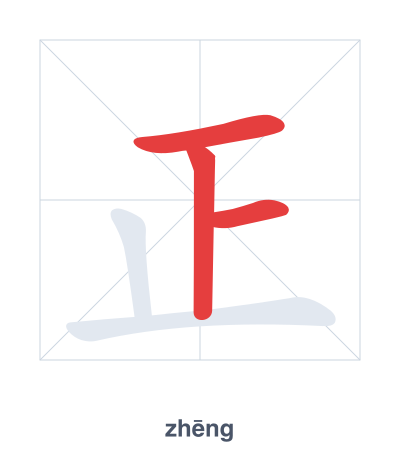
Open Hanzi Writer to see the animated stroke order and practice writing 正 with real-time feedback.
The character 正 (zhēng/zhèng) is written with 5 strokes. Follow the standard Chinese stroke order: top to bottom, left to right, outside before inside. The radical 止 is one of its key components.
Practice the correct stroke order with the Hanzi Writer app to see animated stroke-by-stroke guidance with real-time feedback.
正 means Correct / Upright.
This is a polyphonic character with readings: zhēng, zhèng.
As an HSK Level 1 character, 正 is among the first characters beginners learn.
Ancient 正 depicted a footprint (止) advancing toward a target or city, symbolizing moving straight toward a goal — thus 'upright' or 'correct.' The top horizontal line represents the destination, while the foot beneath shows direct, unerring movement.
💡 Memory Tip: Picture a foot (止) marching straight under a horizontal line (一), perfectly aligned — that's 'correct' and 'upright.'
这道数学题的正确答案是五十。
zhè dào shù xué tí de zhèng què dá àn shì wǔ shí
The correct answer to this math problem is fifty.
我正在家里看书,突然停电了。
wǒ zhèng zài jiā lǐ kàn shū tū rán tíng diàn le
I was reading at home when there was a sudden power outage.
正月里,家家户户都沉浸在春节的喜悦中。
zhēng yuè lǐ jiā jiā hù hù dōu chén jìn zài chūn jié de xǐ yuè zhōng
During the first lunar month, every household is immersed in the joy of the Spring Festival.
Open Hanzi Writer to see the animated stroke order and practice writing 正 with real-time feedback.
✨ Animated stroke order · Handwriting recognition · HSK-graded practice · Free to use
正 is made of a horizontal line (一) on top and the radical 止 (stop) below, which together suggest 'stopping at one' – staying on the correct path. The straight lines and balanced shape visually represent something upright and proper, matching the idea of correctness.