北 (běi) means "North" in Chinese. It has 5 strokes with the radical 匕, and is HSK Level 1.
Rated 2.2/5 in difficulty (moderate).
Harder than 23% of HSK Level 1 characters.
Appears in 3+ common words including 北京 (běi jīng), 北边 (běi biān), 东北 (dōng běi).
Hanzi Writer's stroke validation shows learners typically need 5-8 attempts to write 北 with correct proportion and order.
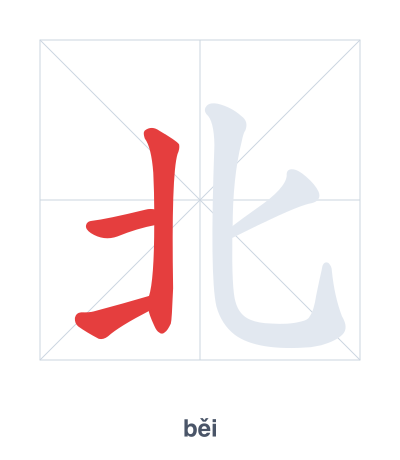
Open Hanzi Writer to see the animated stroke order and practice writing 北 with real-time feedback.
The character 北 (běi) is written with 5 strokes. Follow the standard Chinese stroke order: top to bottom, left to right, outside before inside. The radical 匕 is one of its key components.
Practice the correct stroke order with the Hanzi Writer app to see animated stroke-by-stroke guidance with real-time feedback.
北 means North.
As an HSK Level 1 character, 北 is among the first characters beginners learn.
Originally pictographed two people standing back-to-back, representing 'opposite' or 'back'. Over time, its meaning shifted to 'north' because when you face south (the traditional direction of honor), north is the direction behind you.
💡 Memory Tip: Two people (匕 sitting back-to-back) are both facing north, shivering because the cold wind comes from that direction.
我在北京工作。
wǒ zài běi jīng gōng zuò
I work in Beijing.
学校在北边。
xué xiào zài běi biān
The school is in the north.
他是东北人。
tā shì dōng běi rén
He is from Northeast China.
Open Hanzi Writer to see the animated stroke order and practice writing 北 with real-time feedback.
✨ Animated stroke order · Handwriting recognition · HSK-graded practice · Free to use
北 is composed of the radical 匕 (a spoon or dagger), but its meaning comes from the pictographic representation of two people sitting back to back. This image of opposing directions symbolizes the concept of 'north' in ancient Chinese.