帮 (bāng) means "To help; a gang." in Chinese. It has 9 strokes with the radical 巾, and is HSK Level 1.
Rated 3.5/5 in difficulty (challenging).
Harder than 78% of HSK Level 1 characters.
Appears in 3+ common words including 帮忙 (bāng máng), 帮助 (bāng zhù), 帮手 (bāng shǒu).
Due to its 9 strokes, Hanzi Writer's error detection shows 帮 requires focused practice — most learners need 10+ attempts for consistent accuracy.
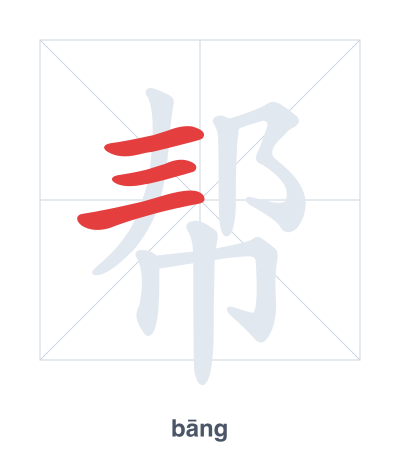
Open Hanzi Writer to see the animated stroke order and practice writing 帮 with real-time feedback.
The character 帮 (bāng) is written with 9 strokes. Follow the standard Chinese stroke order: top to bottom, left to right, outside before inside. The radical 巾 is one of its key components.
Practice the correct stroke order with the Hanzi Writer app to see animated stroke-by-stroke guidance with real-time feedback.
帮 means To help; a gang..
As an HSK Level 1 character, 帮 is among the first characters beginners learn.
帮 is a compound character combining phonetic 邦 (bāng, meaning 'state') with the radical 巾 (cloth). Originally it referred to the upper part of a shoe, which supports the foot; this idea of support extended to 'to help' and later to a 'gang' (a group that helps each other).
💡 Memory Tip: Imagine a gang member using a cloth (巾) to bandage a friend's wound, showing help in action.
邻居家的王大爷经常主动过来帮忙修理水管。
lín jū jiā de wáng dà yé jīng cháng zhǔ dòng guò lái bāng máng xiū lǐ shuǐ guǎn 。
Grandpa Wang, our neighbor, often takes the initiative to help fix water pipes.
谢谢你的帮助。
xiè xiè nǐ de bāng zhù
Thank you for your help.
他是我的好帮手。
tā shì wǒ de hǎo bāng shǒu
He is my good helper.
Open Hanzi Writer to see the animated stroke order and practice writing 帮 with real-time feedback.
✨ Animated stroke order · Handwriting recognition · HSK-graded practice · Free to use
帮 is made of two parts: on the left is 邦 (bāng, meaning 'state' or 'country'), which gives the sound, and on the right is 巾 (jīn, meaning 'towel' or 'cloth'). In ancient times, cloth was used to tie things together, suggesting a 'group' or 'gang', and later the meaning expanded to 'to help' as people in a group assist each other.