爸 (bà) means "Dad" in Chinese. It has 8 strokes with the radical 父, and is HSK Level 1.
Rated 3.2/5 in difficulty (challenging).
Harder than 68% of HSK Level 1 characters.
Appears in 3+ common words including 爸爸 (bà bà), 老爸 (lǎo bà), 爸妈 (bà mā).
Due to its 8 strokes, Hanzi Writer's error detection shows 爸 requires focused practice — most learners need 10+ attempts for consistent accuracy.
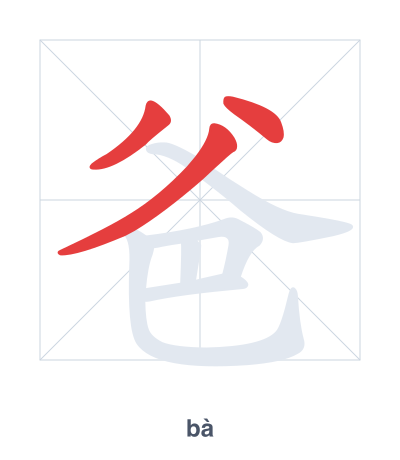
Open Hanzi Writer to see the animated stroke order and practice writing 爸 with real-time feedback.
The character 爸 (bà) is written with 8 strokes. Follow the standard Chinese stroke order: top to bottom, left to right, outside before inside. The radical 父 is one of its key components.
Practice the correct stroke order with the Hanzi Writer app to see animated stroke-by-stroke guidance with real-time feedback.
爸 means Dad.
As an HSK Level 1 character, 爸 is among the first characters beginners learn.
This character combines the radical 父 (father, pictograph of a hand holding an axe, symbolizing male authority) with the phonetic component 巴 (bā, originally a snake), creating a sound-meaning compound that means 'dad'.
💡 Memory Tip: Imagine your dad (父) opening his mouth wide (巴) to say 'ba-ba' as a funny sound.
爸爸去上班了。
bà bà qù shàng bān le
Dad has gone to work.
老爸,生日快乐!
lǎo bà shēng rì kuài lè
Happy birthday, Dad!
爸妈都在家。
bà mā dōu zài jiā
Mom and Dad are both at home.
Open Hanzi Writer to see the animated stroke order and practice writing 爸 with real-time feedback.
✨ Animated stroke order · Handwriting recognition · HSK-graded practice · Free to use
爸 is made of two parts: the radical 父 (father) on top and 巴 (bā) below. The radical hints that the meaning relates to a father figure, while 巴 provides a pronunciation clue, as it sounds like the first syllable of 爸 (bà). Together, they form the character for 'dad'.